
Posted by am933
28 September 2026In June 2026 I spoke about the Containing Pregnancies research at the Feminist Miscarriage Project Conference, hosted in London by the University of Loughborough. The Feminist Miscarriage Project is organised by Dr Victoria Browne (Loughborough) and Professor Susie Kilshaw (UCL) and brings together the full spectrum of pregnancy endings – from miscarriage to abortion – to challenge and extend ways of thinking about pregnancies that do not end in live birth.
The conference was an incredibly stimulating two days of interdisciplinary and international researchers finding connections between their work, from the social sciences to philosophy, psychology, medicine, art, history and English literature. It was great to connect with old colleagues and meet in person some of people whose work I’ve only known from a distance – finally meeting Marita Hennessy, Niamh Howard-Jones and Keelin O’Donoghue from Cork Pregnancy Loss Research Group, Jill Wieber Lens from Iowa, and Sian Beynon-Jones from York. An in-person keynote by Professor Linda Layne, who examined my PhD online during the pandemic, was a highlight, as was the call to action of keynote Dr Annabel Sowemimo. Victoria Newton presented research about the experiences of pregnancy endings in the workplace that I’ve been involved with through the Early Pregnancy Endings project. And I learnt about the new work of so many others that I’ll be reading and watching out for in future.
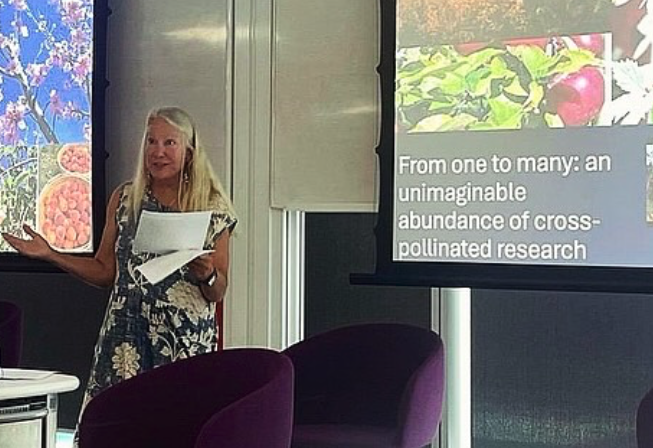
For Containing Pregnancies, I presented evolving work on NHS England’s Saving Babies Lives’ Care Bundle. Since 2016, the National Health Service (NHS) in England has prioritised addressing pregnancy and baby loss in maternity care through its policy entitled ‘Saving Babies’ Lives’, currently in its third iteration (2023). This ‘care bundle’ has evolved from a focus on stillbirth to seeking to reduce all ‘perinatal mortality’. The policy is aimed at the providers and commissioners of maternity care, in a system where the NHS is a national service, but provision is commissioned at local level and monitored through targets and linked funding. It is deeply biopolitical in its scope, seeking to reduce population-level stillbirth and neonatal mortality rates and recommending action on pregnant bodies to achieve this. In my paper, I considered the reproductive governance of pregnancy and baby loss through a critical feminist analysis of ‘Saving Babies’ Lives’ including identifying specific reproductive governance strategies in the policy. I am now developing the paper for publication.