
This year’s Images of Research competition closes Monday 5 October 2026, so for some last-minute inspiration, read on to hear from some of the 2025 winners as they share some further insight into their research and how their images came about.
The annual Images of Research competition, run by the Researcher Development and Research Culture team, enables Early Career and Postgraduate researchers to practice key skills in communicating their research to a non-specialist audience. The competition provides increased exposure of their research through an exhibition and an addition to their CV.
For our colleagues and student community – as well as members of the public – the resulting exhibitions provide a fascinating insight into some of the great research undertaken at our university.
Let’s hear from our 2025 winners below:
Postgraduate Runner up – ‘Seeking Shade in a Warming World’, Veronica White
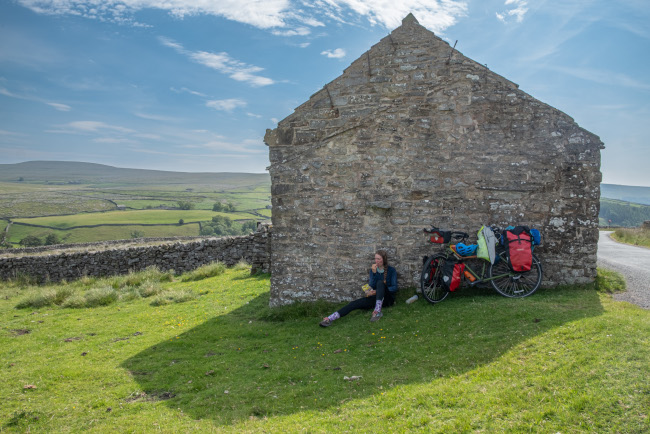
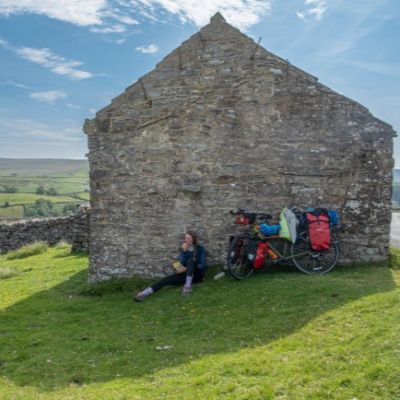
Last spring, I cycled across England for my PhD fieldwork, stopping along the way to interview women in farming communities about their visions for the future of farming. As a photographer, it was an incredible opportunity to capture the farmed landscapes I was riding through and I ended up taking over 10,000 photos, using my digital camera, phone and drone. When I saw that the Images of Research competition was open to postgraduate researchers, I knew I wanted to enter one of my photographs – the challenging part was narrowing it down to just one image!
After going back and forth on a few different images, I eventually decided to submit a self-portrait I had taken in the Yorkshire Dales. It was one of the hottest days of my fieldwork, and after setting up my tripod to take a few photos, I rested in the shade of a stone barn, eating candy to fuel me up one of the longest climbs of my ride. Writing the image caption for the competition helped me tell the story of the image – I wanted to share the adventurous side of my fieldwork, but also the story of the farmed landscapes I was riding through and the challenges climate change is already posing to these landscapes.
As a visual communicator, I always appreciate opportunities to share my research in creative ways and I enjoyed the challenge of narrowing down my library of images to a single photo that could tell the story of my research. And I was thrilled to learn I had been chosen as the runner up! As I work on writing up my thesis, I will continue to share my research on social media (@farmingfutures_cycle on Instagram), as well as at conferences and other events.
We live in a visual world and I love that this competition encourages us to consider how imagery can be used to communicate our research. I loved seeing all the other competition entries – the competition booklet really highlights the incredible variety of research being conducted by PhD students at the university!
Early Career Runner up – ‘Synergy’, Nicholas Clifton & Alice Franklin
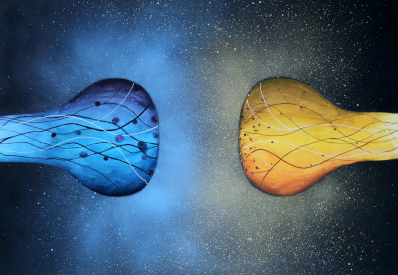
Despite many of us sharing a common area of research, how each of us visualises the mechanisms underlying our research findings can vary substantially. We undertake research studying brain development with the aim of understanding how genetic risk factors contribute to the emergence of neurodevelopmental and psychiatric conditions.
We have quite different academic backgrounds and use different strategies to construct internal visual models of the underlying biology. Creating artistic representations of these mental visualisations is a great way to share how we conceptualise the science.
Using watercolour and aerosol paint, we collaborated on the depiction of this synapse, one of the trillions of cell-cell connections in our brain which mediate our cognitive development, learning and memory. These one-directional junctions pass information from one cell to the other using chemical messengers through a complex cascade of events that may become disrupted in neurodevelopmental and psychiatric conditions.
In bringing together our distinct perspectives within a single image, the piece also reflects the broader collaborative nature of our research team, where interconnected ideas and complementary expertise form a network not unlike the neural systems we study.