
Dr Tamara Al Khalili is a Lecturer in Education Policy and Leadership at the School of Education and a researcher on a British Academy-funded project examining disability rights in higher education. Her research focuses on inclusive education, educational inequalities, and the experiences of marginalised groups in education. Below, she reflects on a Researcher-led Initiative (RLI)-funded project that she led to explore and enhance the wellbeing and resilience of postgraduate researchers and early career researchers with parental and caring responsibilities.
Behind every research paper, conference presentation, or grant application is a person with a life beyond academia. For many postgraduate researchers and research staff, that life includes caring for children with Special Educational Needs and Disabilities, a role that brings immense love and fulfilment but also emotional, practical, and professional challenges. Too often, these experiences remain invisible within academic culture. Recognising this gap, I led a three-phase project funded by the Researcher Development and Research Culture Team. The aim was to create a supportive community where researchers could connect, reflect, learn from one another, and develop strategies for sustaining both their academic careers and wellbeing.
Phase One: Sharing Stories, Building Community
The journey began by creating space for something that is often missing in academia: honest conversations about caregiving. Researchers from different career stages came together to share their lived experiences of balancing academic life with caring responsibilities. What emerged was not simply a series of talks, but a reminder that vulnerability can foster connection and that sharing our stories helps us realise we are not alone.
Four speakers shared their journeys. Alison Pearson reflected on navigating her PhD while parenting, introducing her practical strategy of “two golden hours” by setting aside two focused hours each day for uninterrupted work. She also highlighted the importance of shared caregiving, realistic planning, and manageable daily task lists. Rachel Griffiths offered a moving reflection on self-care, explaining how singing in a community choir provides far more than relaxation. It offers identity, belonging, and joy beyond the multiple roles she occupies. Martina Egedusevic spoke about conducting research while caring for a newborn without maternity leave, reminding us that academic careers rarely unfold under ideal circumstances. Lyndsey Carmichael, highlighted the importance of community through the University’s Parents and Families Support Group, demonstrating how peer networks can make an enormous difference in reducing isolation. Together, these stories transformed individual struggles into collective understanding.
Following these conversations, participants engaged in a creative collage workshop facilitated by Ludmila Centurión. Against a backdrop of calming music, participants responded to two reflective prompts:
- What matters to me?
- Why do I matter?
Using magazines, coloured paper, handwritten reflections, and drawings participants created visual representations of their identities, aspirations, and challenges. The workshop reminded us that creativity offers something academia often overlooks: space for emotion, imagination, and self-expression. Rather than measuring ourselves by publications or productivity, participants explored the richness of their identities beyond academic outputs. Through art, participants found new ways to articulate the complexity of balancing research with caregiving responsibilities.
Phase Two: Creating Space to Rest
While the first phase focused on connection, the second phase centred on restoration.
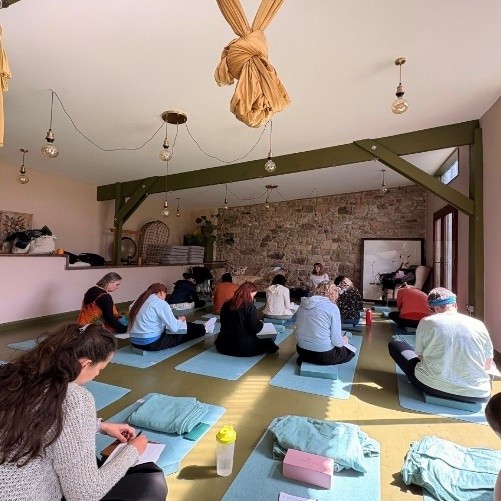
Held at the beautiful Southcombe Barn at Dartmoor, a wellbeing retreat was designed as an opportunity for researchers to pause, a rare experience within the relentless pace of academic life. Facilitated by Rosanna Elliott, the day followed a carefully designed restorative flow. Participants experienced restorative yoga, reflective journaling, a sauna session, a refreshing river plunge, and a guided walk in nature.
Throughout the day, Rosanna introduced Suzy Reading’s framework and the concept of the Eight Pillars of Rest from her book Rest to Reset (2023), encouraging participants to rethink rest not as a luxury, but as an essential foundation for sustainable wellbeing. Perhaps the most powerful takeaway was wonderfully simple. Even a few moments of intentional pause, feeling your feet on the ground, noticing your breathing, or stepping outside into nature, send an important message to both body and mind: You matter too.
Phase Three: Telling Our Stories Through a Collective Zine
The final phase of the project turns reflection into creation.
Across two workshops, participants worked alongside arts educators Ludmila Centurión and Katie Scott-Hamilton to co-create a collective zine exploring the realities of combining research with caring responsibilities.
Participants had freedom to contribute in ways that felt meaningful to them. Some chose poetry, others created drawings, photographs, short reflections, or personal narratives. All materials were provided, creating an inclusive and welcoming environment where artistic experience is unnecessary.
Each contribution became part of a shared publication that celebrates diverse voices while documenting the often-unseen realities of academic caregiving.
Looking Ahead
One message echoed throughout this project: resilience is not simply about enduring difficult circumstances, but about being supported to thrive. Three lessons stand out:
- Create spaces for connection: Peer support can reduce isolation and foster a sense of belonging.
- Make caring visible: Open conversations about parenting and caring can help challenge the expectation that these responsibilities should remain separate from academic life.
- Build support into structures: Wellbeing should not rest solely on individuals’ capacity to cope; institutions and research communities have a role in creating inclusive and supportive environments.
Ultimately, supporting researchers with caring responsibilities is not about making them more resilient; it is about creating environments where they can thrive.
Check out The Academic Caregiver Toolkit by Tamara Al Khalili.