
Contributors
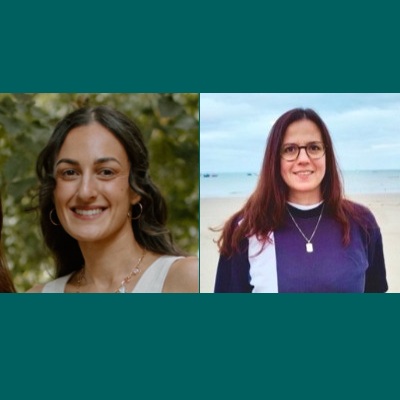
Hayley Redman (she/her- pictured on the left) – Hayley is an SWDTP-funded PhD student in the department of Public Health and Social Sciences. Her research is an interdisciplinary qualitative study which concerns fathers’ experiences of neonatal palliative care.
Ksenia Lavrenteva (she/her- pictured on the right) — Ksenia is a SWDTP-funded PhD researcher at the Law School and Department of Geography. Her socio-legal research develops the concept of Embodied Data Rights, a framework for understanding and governing how data derived from human bodies are captured, managed, owned, and reused.
There is lots of advice and guidance out there for ‘surviving’ the first year of the PhD, and lot of advice and guidance on the final push of getting ready to hand in during your final year, but relatively little available on the ‘middle’ of the PhD. As a student, it can feel like there is no road map to work from, sometimes leaving you feeling a bit lost in the thick of it.
In this blog in two parts, Ksenia and Hayley share their experiences of the second year of the PhD, reflecting on some of the challenges they have faced and discuss ways to overcome this.
Note, we recognise that not all PhD programmes will be three years, this blog is intended to reflect on the ‘middle’, the time between completing the PhD upgrade and the typical final ‘writing up’ year.
The absence of structure and deadlines
During the first year of the PhD the upgrade deadline often looms over you – everyone asks when it is, how prepared you are, if you’ve submitted your report, will you do a presentation… but once it has done there can often be no more hard deadlines to work towards.
The upgrade also gives you a very clear idea of what you are working towards and what you are expected to achieve by the end of your first year – a research outline and a chapter draft (it might differ across departments). This gives a sense of direction and helps to prioritise between different tasks.
In the second year, there is often no equivalent deadline or clearly defined milestone to work towards. This can create a false sense that you finally have time to do things properly. But time is very limited and there is always a danger to overthink. Remember Parkinson’s Law: “Work expands so as to fill the time available for its completion.”
What is more, the intensity of work can really fluctuate throughout the PhD journey, you can spend weeks of long days at your laptop polishing off a journal article or your ethics application before submission, to then hear nothing for weeks on end, feeling at a loose end and refreshing your email every five minutes!
The tip here is to create your own deadlines and set yourself specific goals and not to wait for your supervisors to tell you what to do next or do things as time allows. Take this blog as an example. We put a deadline for it in our diaries and gave ourselves two weeks to complete it. In the end, it was basically written up on the day of the deadline and finished it the following day. Deadlines matter!
At the same time, it is important to remember that “the best laid plans go awry” and this is certainly true during the PhD. We can spend months meticulously planning our work, for something to change last minute. For example, Ksenia’s lead supervisor left the university after her upgrade, which inevitably led to changes in her research and some delays as she adjusted and established a relationship with her new supervisor.
Therefore, embrace uncertainty and be flexible with your plans and deadlines, especially if you do empirical research.
Cycle of ‘not writing’
We often hear the advice to ‘start writing early’ or to ‘always be writing’, but this can be really difficult when it feels like you have nothing to write.
We often fall into the trap of thinking that only perfectly polished, thesis ready writing counts, and motivating yourself to write something that doesn’t feel like it’s going anywhere can be challenging. However, removing the pressure of thinking something needs to be thesis or publication ready can help get words down on the page! Some of the ‘concept notes’ Hayley has drafted on various topics just for herself without the pressure of thinking they need to be polished for publication have been super useful when it has come to drafting conference abstracts or writing up presentations.
Ksenia has started a field diary to practise everyday writing, and so far, it has been one of the most useful experiences, helping in three ways. First, it helps to think things through. Writing is a different form of thinking, having an idea is not the same as writing it down. As soon as you put it on paper, you have to put it into context, formulate it, and explain it properly, even if only to yourself. Second, writing things down reduces cognitive overload. Instead of trying to keep everything in your mind, you create an external space to store your thoughts. Third, when you come back to your writing, you do so from a different position – as a reader. This creates some distance between you and your thoughts and helps you to be more reflective and critical.
So, even if you feel that you have nothing to write about, you can always keep a diary or make some notes for yourself. It will be tremendously helpful in the future, we promise!
Stop comparing!
Remember everyone’s PhD timelines will look different, and to talk with your supervisor if you are concerned, as they can reassure you and help you set realistic targets and expectations for your own study. Comparison really is the thief of joy, so celebrate your peers’ successes and know that you’re also on the right track for your PhD.
In our next blog post, we will be thinking about some of the opportunities available to you during the PhD journey.