
Posted by The Law School
3 December 2025Lucy Halley is a second year Law LLB student whose passion for writing blossomed during the quiet of lockdown and has led to her signing a publishing deal for her debut novel, Hyacinthus. She took time out of her studies to share her love of antiquity, how she balances her studies and writing, and why patience and persistence are key to getting that first break.
What got you into writing, is it something you have always done or picked up more recently?
I began to take writing more seriously around 2020/21 as the national lockdowns provided me with a considerable amount of time to write. During this period I wrote a short novel which, while it won’t be seeing the light of day any time soon, it taught me a great deal about the art of writing and the intricacies of crafting a novel-length story.
Between 2023-24 I wrote, rewrote, and edited ‘Hyacinthus’ alongside studying for my A-Level exams. I am incredibly proud of how far my writing has come and I am thrilled to be in the position to publish my debut novel!
Where did your love of Greek and Roman ancient history and myths stem from?
Around the time I began taking writing more seriously I developed an interest in Ancient Greece/Rome through my reading. This was both through series such as Percy Jackson (which I still dearly love to this day), as well as novels that retold or rewrote Greek/Roman myths. As a result, when I applied for my A-Levels, I decided to take Classical Civilisations so that I could learn more about these eras and their myths at a more academic level. I’m really grateful that I did this as without this study I don’t think the history and mythology of ‘Hyacinthus’ would be as well fleshed out.
During my Classics A-Level, I had an incredibly inspiring teacher named Sam Desmond at Richard Huish College who both pushed me to succeed academically and made me fall even deeper in love with Ancient Greece and Rome in the ways that she described classical art, the Iliad, Greek philosophers, and the foundation of the Roman Empire. She also inspired me to write ‘Hyacinthus’ as she was the one who first introduced me to the myth in a Greek art lesson.
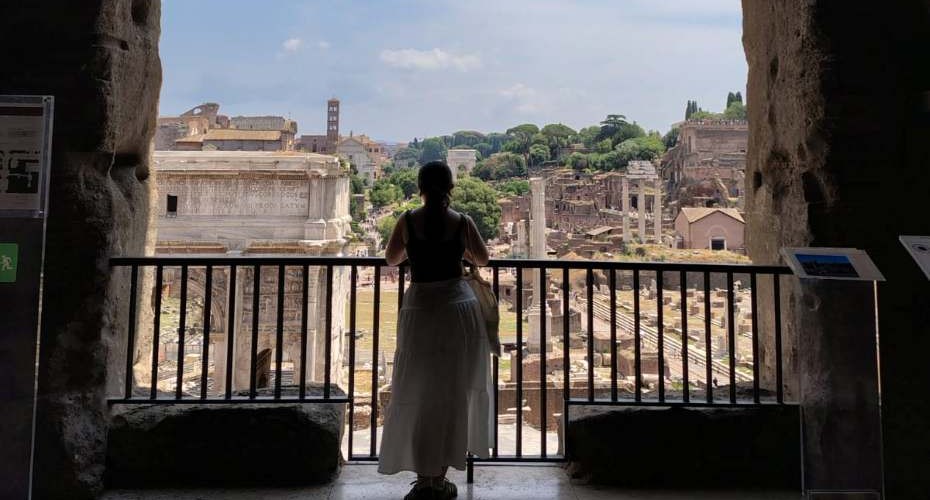
Since deciding to take this A-Level, I have also been incredibly fortunate to visit both Greece (various cities) and Rome twice, which has really cemented my love of both histories and mythologies.
Tell us about the background to securing the book deal for Hyacinthus.
In September 2024, the same month as I started uni, I began querying my novel. ‘Querying’ is the process where an author sends out the first few chapters of their book, accompanied by a cover or ‘query’ letter, to literary agents and publishers. I sent 110 queries to agents and publishers and received 10 full requests, which is where an agent/publisher requests to read your full manuscript.
One of the issues I found is that it can be difficult to gain an agent or a publication contract for certain genres at certain times in the industry. Due to the growth of the myth retelling genre ( a genre I deeply admire for producing some of the most beautiful novels I’ve read) the market has become saturated from a publisher’s perspective. Several agents I approached already represented authors in this genre and were reluctant to take on another to avoid internal competition. In contrast some agents did not feel that they had the right connections to help me publish a myth retelling novel. As a result of this, I did receive quite a few rejections from agents, however this sting was lessened by the praise they offered of my narrative voice, even if they were unable to sign me.
Despite this initial setback, I soon received strong interest in my novel from two publishing houses. Through conversations with a friend who was familiar with Ipomoea Publishing, my now publisher, and by reaching out to Ipomoea’s first published author, I quickly realised how many benefits there are in publishing a novel with an independent publisher, that is to say a publisher not in the ‘Big Five’. I have found that as independent publishers are more specialised and specific with the books they publish, they often have more time to spend on individual projects and allow the author greater involvement in the publishing process.
When I had my first meeting with my publisher back in November/December 2024, I was thrilled to learn how much they had enjoyed reading the first few chapters of my novel and how genuinely invested they were in my story, which made it clear to me that they were an absolute dream publisher. I was so captivated in publishing with them that I would spend hours refreshing my inbox after sending them the full manuscript.
In April 2025, I was delighted to escape the process of ‘querying’ when I received Ipomoea’s offer of publication. The journey of querying my debut novel has truly taught me so much, and I feel incredibly blessed to have signed a publishing contract and to have announced my publishing deal to the world within 12 months of sending my first query letter!
What do you like about this genre, and is this the only style of writing you do?
What I love most about the historical fantasy genre is how it allows authors to blend together the real and the extraordinary. For example, in ‘Hyacinthus’, I have set scenes in real Ancient Greek cities and even in buildings that I myself have seen the ruins of. I think historical fantasy is quite unique in this aspect. More specifically, I love myth retellings as authors are able to breathe new life into a story that has been around for thousands of years. This is even more the case with myths where little is known about the ‘middle’, which allows authors a lot of creativity in deciding how to shape the story.
Although I have branched out from the historical fantasy genre, everything I write will have a historical pull. For example, the novel I am currently editing is much more grounded in history, but does still contain a few fantastical elements, and the novels I have planned to write in the future are all set in certain eras of history or draw from it in some way. Setting my novels in history – particularly in antiquity, classical antiquity, and the early modern era – is a great source of joy to me as in planning and writing these novels I am able to explore my favourite historical eras in great detail.
Which authors do you admire/enjoy reading for your own pleasure?
There are a variety of writers that I enjoy reading, however the authors that I most admire and that have inspired my writing so far are Costanza Casati, particularly her novel ‘Clytemnestra’, Madeline Miller, and R. F. Kang. Each of these authors all have something really unique about their writing style that I find intriguing, and all of their novels are crafted with such beautiful precision. I have devoured many of their novels in just a few days and I can only hope that my descriptions and narratives will one day live up to theirs.
How do you balance the demands of your degree with your passion for writing?
While a lot of my time outside of lectures and seminars is taken up by completing reading and essays, I always make sure to set aside time for writing wherever I can. I am a commuter student who catches the train to University, so where I am able to I will set aside time on these journeys to and from uni to write. I also utilise holidays or breaks from University to write more, especially in the summer break.
Although challenging, I am really glad that I have continued to write alongside my degree as it has provided me with a creative outlet. I firmly believe that fiction writing has had a positive impact on my degree through enhancing my essay writing and critical analysis skills.
With one book now being published, what are your plans for subsequent books?
I am currently completing my first round of edits for my second novel ‘Achillia and Amazon’, a historical fiction novel set at the very end Emperor Domitian’s reign in Ancient Rome. I am hoping to ‘query’ both literary agents and publishers with this in early to mid 2026. I am also outlining/planning a historical speculative novel set in Renaissance Rome – I definitely seem to have found my favourite city to set novels in!
Any advice/top tips for other young writers?
I would advise any other young writers to really savour the process of writing and seeking publication. You have to be really patient to pursue publication as the publishing industry does move at a snail’s pace, but when you do receive interest in your book, the world feels as if it starts moving in 2x speed and you’ll likely feel grateful when it slows back down again.
I would also advise them that their writing dreams/aspirations might unfurl in a way that is unexpected or less conventional. For example, when I first started pursuing publication, I was under the impression that you needed a literary agent to obtain any sort of publishing deal, but a vast number of independent publishers are open to direct submissions from writers, just like my publisher. Therefore, it can be a good idea to query novels to both literary agents and independent publishers, particularly ones that publish worldwide, to increase the chances of obtaining a publishing deal.