
Posted by Edward Mills
10 November 2026Yes, we are indeed still here! Readers of this blog could be forgiven for wondering whether the Centre for Medieval Studies here at Exeter was still active, or whether we had, like a text with a frustrating manuscript tradition, simply stopped abruptly, never to finish what we’d started. Well, we’re happy to announce that we’re back — or, rather, we will be.
The last few months have seen a few developments across the Centre. In particular, a number of valued colleagues left the University during changes at the University over the summer. With colleagues having to adapt quickly, it wasn’t feasible to maintain the steady stream of medieval blog content to which regular readers will have become accustomed, and accordingly, the blog (and, indeed, the Centre as a whole) have collectively decided to take a few months to regroup and focus on the future.
We feel that it’s important to continue the work of the Centre, about which we all care deeply. Since its inception, the Centre for Medieval Studies has been a labour of love, one built on and maintained by the passion, care, and interest of a community of like-minded students, teachers and researchers; we’re eager to continue sharing the joy that we all find through our work on the familiarly strange, and strangely familiar, medieval world.
So, what’s happening? The blog will return, in all its weekly glory, in January, and we’re already looking forward both to welcoming back some familiar faces and introducing exciting new voices. January will also see the return of a formal programme of events, as our reading groups start up again and opportunities to share our work — in both familiar and novel formats — are publicised once more. Before then, you can expect occasional posts on this blog, as we publicise those events that are going ahead this term; in particular, we’ll be hearing from the prolific ‘Learning Anglo-French’ project again in a couple of weeks, as Krista Milne, a visiting fellow on the project, asks what connects the French language in medieval England and the language-learning app, Duolingo.
Exeter medievalists are as energetic as ever in the research sphere, too. To give just a few examples of the new research projects getting underway:
Meanwhile, with the arrival of the Bayeux Tapestry, Levi Roach joined with other Norman experts on BBC Radio 4 to answer ‘What did the Normans ever do for us?’, and Edward Mills contributed to a special edition of Word of Mouth on topic of how the Conquest influenced the English language. James Clark joined Janina Ramirez at Gloucester History Festival to reflect on the wonder of medieval cloisters.
Centre members have long been involved in publishing in the ‘trade’ sphere, as we’ve seen with James Clark’s Dissolution of the Monasteries: A New History (Yale University Press) and Levi Roach’s Empires of the Normans (Hachette). Well, we’re pleased to be adding two new venerable volumes to that list very soon! Catherine Rider will lead the charge in February 2027 with her Familia: The Medieval Making of the Modern Family, with Jennifer Farrell’s new book (Island of Dragons: Geoffrey of Monmouth and the Legendary History of Britain) hot on its heels in April. We’ll be hearing more about these exciting titles as publication dates come closer.
In the meantime, the Centre is always keen to hear from anyone interested in contributing to our events, or (indeed) to the blog. Anyone interested is warmly invited to get in touch with Edward Mills in the first instance. Until then … see you soon!
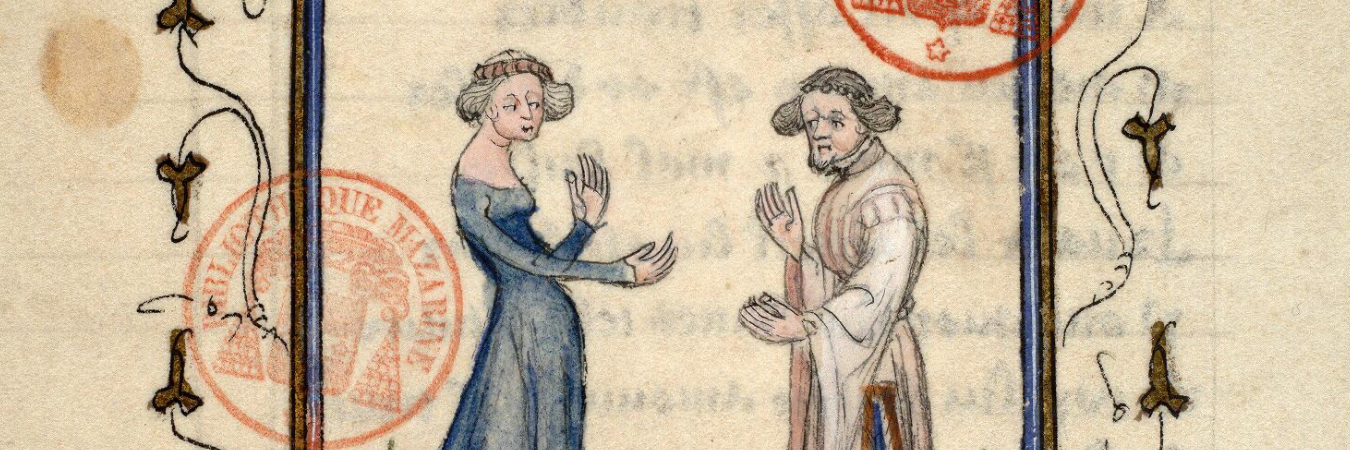
Featured image: Paris, Bibliothèque Mazarine, MS 3872 (fol. 15v).