
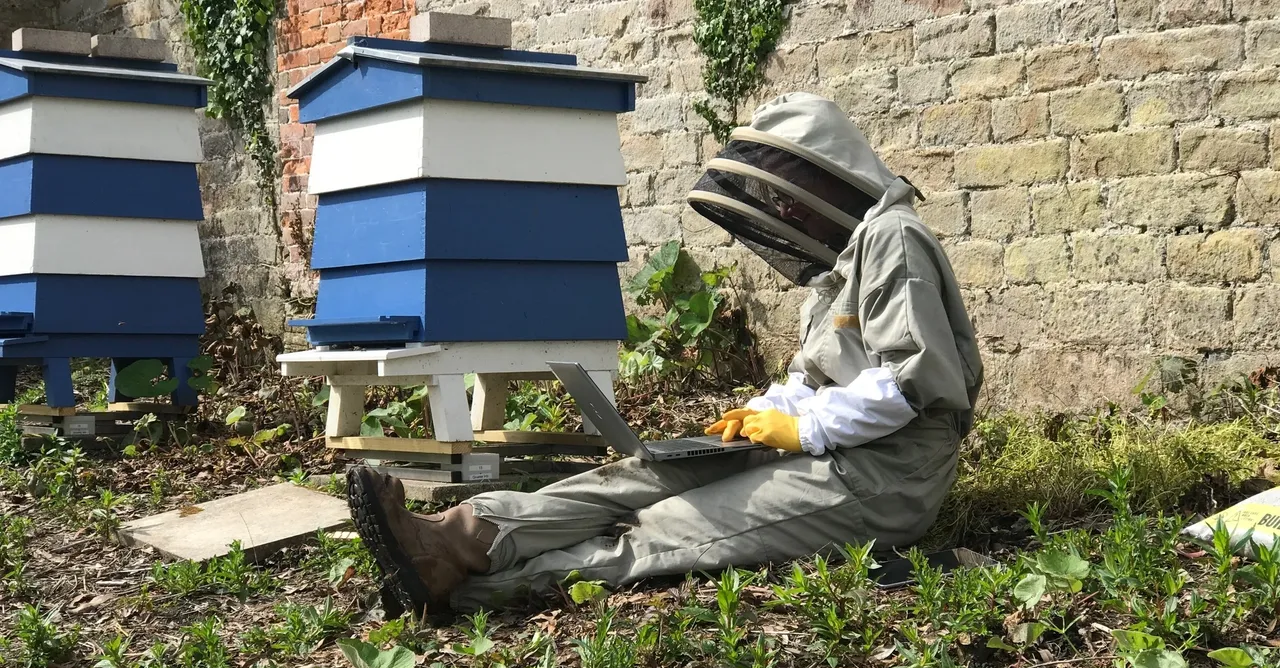
Image credit – a beekeeping partner
Fay Kahane tells us how support from the Patient and Public Involvement and Engagement (PPIE) Fund helped develop her PhD research, working in collaboration with external partners to investigate the future of sustainable beekeeping.
Amount of award: £570
Engaging beekeepers in equitable partnership has been the bedrock of this research from the very beginning. Commencing in 2022, this work began as a PhD funded by the Economic and Social Research Council (ESRC). For too long, academia has instructed practitioners in a one-way system removed from the realities of life on the ground – that is, life with the bees. To understand what sustainable beekeeping is, and how we can and should do it, there is no other way than to collaborate with those who practise it. Undertaking this collaboration respectfully, openly, and with long-term commitment is crucial, but costly. PPIE funding was extremely helpful for this, as my ESRC support grant had come to an end, but our partnership still had work to do!
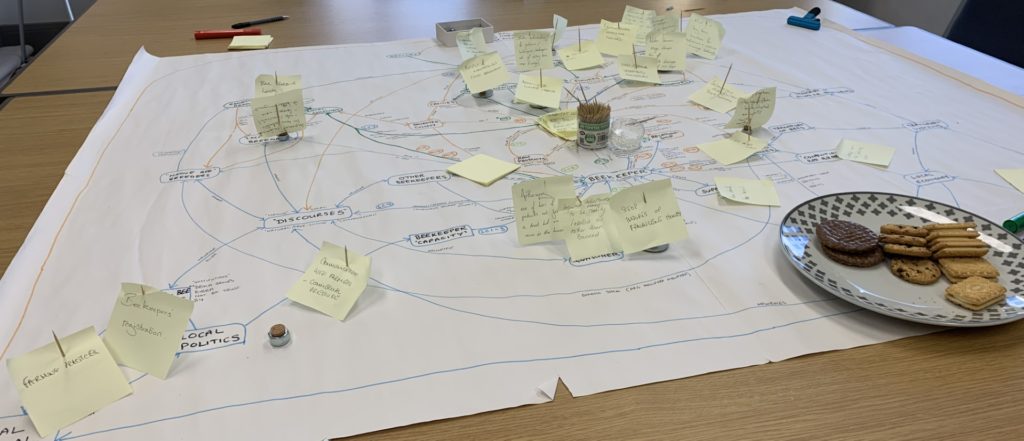
Funding from PPIE enabled me to hold a fifth workshop for the beekeeping partnership (seven experienced beekeepers, an artist, and myself) to discuss ‘future scenarios’ for beekeeping in the UK. We considered in particular the impact of international honeybee trade in the spread of pests and diseases; conservation of native subspecies of honeybee; and how to increase the resilience of honeybees for survival in the wild. We also explored the impact of large-scale beekeeping upon the hundreds of wild bee species, and thousands of other insect pollinator species such as hoverflies, in the UK.
Our partnership is purposefully composed of beekeepers who hold different opinions around what sustainable beekeeping means – including bee farmers, native bee breeders and conventional hobbyists – so potential for disagreement was high. However, under the political theory of ‘Agonistic Pluralism’, which argues that conflict only makes discussions more democratic, we encouraged this debate. By keeping in mind the agreed-upon ground rules, as well as each member’s shared love of and respect for honeybees, these differences helped us reach balanced and well-rounded conclusions that could continue to be challenged. (With PPIE funding, I could also provide plentiful cake and tea, which helped immeasurably!)
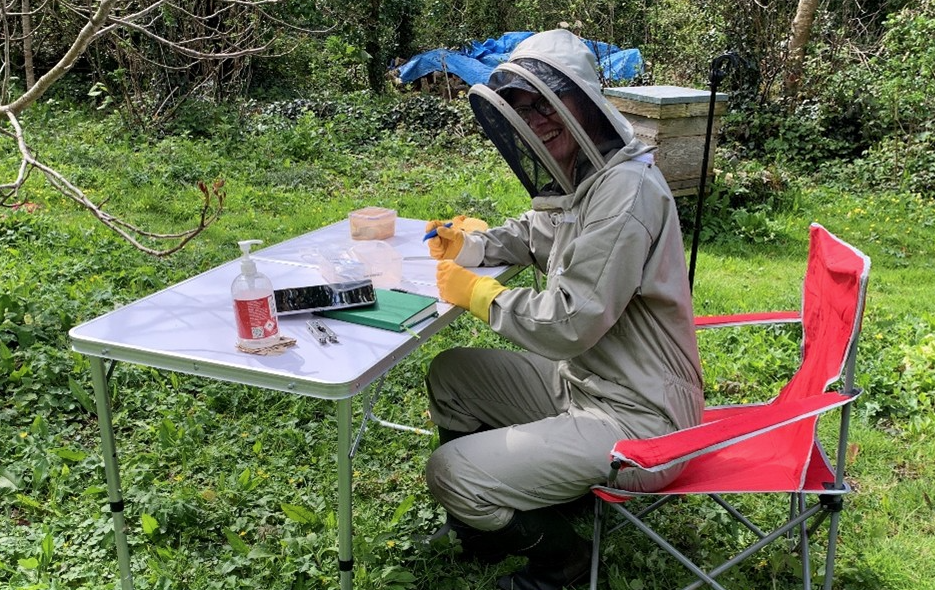
Living and working among scientists, beekeepers, honeybees and wild pollinators, I have a strong commitment to this partnership (and when my children are grown, would love to keep bees myself!). Honeybees are economically, environmentally, and culturally critical insects. As a scientific researcher, my role is to engage with what we can learn from these creatures and the keepers who know them best. By applying a scientific method, I can more effectively convey these findings to decision-makers and practitioners with the power to make a real difference to the future of honeybees and beekeeping.
We have a lot of data, and the partnership is still going strong – I continue to consult the keepers around analytical choices. As the project progresses, I will continue to publish in beekeeping magazines, deliver presentations, and maintain my website: https://ecologycornwall.com/beekeeping-research. I aim to submit my thesis at the end of this year, along with articles for publication in scientific journals – one of which has already been published: https://link.springer.com/article/10.1007/s13280-022-01736-w. Alongside this, I have been working with artists, and am exploring options for using future funding to communicate our findings in creative form, such as interactive visuals, and music!
From our existing partnership work, we are looking to develop an infographic showcasing ‘pathways to sustainable beekeeping’. Our hope is that this resource will provide a clear and accessible tool, which can inform decision-making around honeybee policy and practice for generations to come.