

SmartADHD
  • Consensus Statement on ADHD and Digital Health

    Consensus Statement on ADHD

    and Digital Health

    By European experts in ADHD

    What role could technology play in supporting people with ADHD?

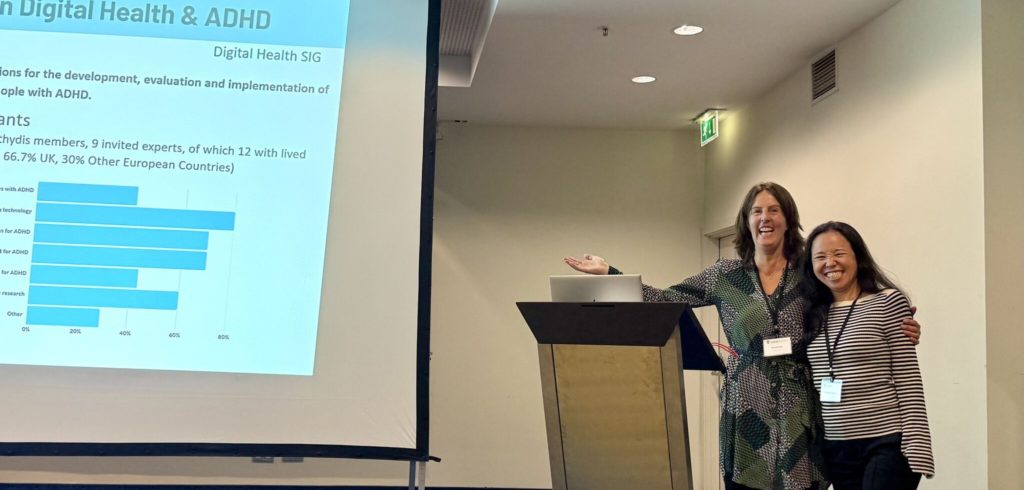
    To help answer this question, members of the SmartADHD team collaborated with ADHD experts from across Europe through the European Network for Attention Deficit Hyperactivity Disorder (EUNETHYDIS). Together, they identified key priorities for the future of digital health and ADHD support.

    Read the statements below or view the full peer-reviewed publication.

    Section 1. Opportunities and Aspirations 

    Digital technologies have the potential to improve health services and support for people with ADHD; however, there is a shortage of evidence-based tools that are suitable for clinical use. The statements in this section represent our consensus on some of the opportunities afforded by digital technologies, if they are rigorously and appropriately co-developed, implemented, integrated, and evaluated. We acknowledge that there is a diversity of contexts, uses and users of digital technologies, and that the evidence base for these potential benefits remains limited to date. Later in this statement, we indicate priorities to develop the evidence base in this area and provide further discussion of the potential risks and unintended consequences. 

    1. Digital technologies could improve timely access to assessment and evidence-based support for ADHD and related challenges. 
    1. Digital technologies could enhance the flexibility and inclusivity of services by accommodating diverse preferences for content, access, language, stimulus types, and interactions.  
    1. Digital technology could extend the reach of high-quality support for ADHD, especially given widespread challenges of limited mental health resources across countries with differing health infrastructure.  
    1. Digital technology has the potential to provide just-in-time data to improve monitoring, feedback, and personalized support, as long as it is user-centred, and addresses privacy concerns. 
    1. Opportunities for improved provision must be viewed in the context of a range of risks and unintended consequences including, but not limited to, unregulated digital development, inappropriate substitution for clinical care, and widening of inequalities. 

    Section 2: Development and Evaluation 

    Development processes for digital health technologies need to be agile and iterative and involve multiple stakeholders. Digital interventions are often complex interventions, and hence more work is needed to identify the necessary adaptations to ensure development and evaluation of digital interventions produce high-quality evidence to support their use. We recommend that methods development is a priority. 

    Part 1: Development 

    1. Digital health product development could be improved through better knowledge and resource sharing among researchers, clinicians, software engineers, and people with lived experience. 
    1. User-centred development is key to ensure technologies are effective, by involving diverse stakeholders early, balancing researcher, clinician, and user priorities, and integrating continuous feedback. 
    1. Researchers need to adopt multidisciplinary ways of working to ensure development integrates different perspectives, varied expertise, and a range of digital platforms and methodologies.  
    1. Development of evidence-based digital technologies for ADHD requires support from institutions and funders to create and resource diverse, user-centred and multidisciplinary teams.  
    1. Digital product design needs to be sensitive to culture and context, as well as meeting clinical and privacy standards. 

    Part 2: Evaluation 

    1. Digital health products should undergo rigorous evaluation to ensure their benefits and avoid harm. 
    1. Guidelines and methodologies are needed to establish a reliable and robust evidence-base, in the context of the rapid and iterative development of ADHD health technologies. 
    1. The development of new technologies offers a potential opportunity for different forms of evaluation beyond traditional methodologies. 
    1. It is important to assess effectiveness, usability, feasibility, and efficiency while incorporating large-scale, continuous real-world feedback. 
    1. Evaluations must address inclusivity, reach, and impact on intended and unintended users.  
    1. Objective and subjective outcome measures should be selected that are appropriate for use in digital environments, while considering and minimizing user burden. 
    1. Adverse effects must be identified and evaluated, including consideration of the ways ADHD characteristics can impact attention, learning, motivation, and technology dependence.  
    1. Research should report on user involvement and engagement, study design justification, and clinically meaningful outcomes including risks and unintended consequences. 

    Section 3: Implementation 

    Priority statements for the implementation of digital health technologies for people with ADHD. We emphasise the importance of carefully considering the context of implementation, as well as the integration and interaction of digital and non-digital elements of care in complex healthcare systems. Training, support and infrastructure are also essential for successful implementation and integration of these technologies, with further work needed on what specific ‘digital competence’ might be needed for clinicians working with people with ADHD. 

    1. Integrate digital technology into comprehensive support for ADHD whilst recognizing its clinical, technical, evidence and equity limitations. 
    1. Employ multi-disciplinary and community-participatory strategies, in order to make sure digital technologies are usable and useful in real-world settings.  
    1. Those implementing digital technologies need to take responsibility for educating users about digital health products, their quality, and how to select suitable options.  
    1. Clinicians working with people with ADHD require training and support to ensure they have the necessary competences to use digital health technologies in their practice. 
    1. Health and care services using digital technologies must have appropriate infrastructure and technical support in place to support end-users, protect privacy, and avoid increasing the burden on clinicians or people with ADHD.  
    1. Those implementing digital technologies must ensure transparency about data collection, privacy protections, and product limitations.  
    1. There is a need for researchers, and developers to consider sustainable implementation strategies including industry partnership, conducting economic evaluations, and planning for iterative development. 

    Section 4: Risks and Unintended Consequences 

    We discuss the opportunities presented by digital technologies for people with ADHD, but we also recognise that there are risks, and unintended consequences, which may be positive, negative or mixed. This emphasises the importance of careful and rigorous development, implementation and evaluation, and of paying attention to the ethical use of health technologies. 

    1. Digital health technologies for ADHD may be used in a range of ways and contexts, and therefore the risks and unintended consequences may be unpredictable, and specific to the user/s and the system. 
    1. There are obvious risks relating to widening inequalities due to digital exclusion and other factors, and ways to monitor and mitigate this risk require further consideration.  
    1. Care must remain person-centred. It must be recognised that not everyone benefits from or prefers digital tools, and that some individuals with ADHD or with co-existing conditions may face challenges in interacting with digital technology.  
    1. The use of digital technologies with children with ADHD and their families may also require specific consideration around issues and potential risks such as consent, privacy, and screen time. 
    1. There is a risk that digital interventions may be used to replace rather than augment non-digital services, and hence we emphasise the importance of an integrated approach, and the provision of appropriate alternatives.