

Real change for childhoods: Reflections from the Better Start Conference
On the 5th of March I had the opportunity to attend the Better Start Conference in Blackpool, held at Blackpool Football Club and centred on a powerful theme: “Real change for childhoods.” The day brought together practitioners, researchers, policy colleagues, community organisations and, importantly, parents themselves to ask a deceptively simple question: what does genuine systems change in the early years sector look like?
Better Start was a 10-year, £215 million investment by The National Lottery dedicated to tackling health inequalities in early child development through five place-based sites across England: Blackpool, Bradford, Lambeth, Nottingham, and Southend-on-Sea. Better Start was crucially designed as a test-and-learn programme, supporting local partners to redesign early years systems in partnership with parents and communities, while generating evidence and learning for the wider sector. Now that the 10-year experiment has concluded, attention is turning to how its insights, partnerships, and momentum can be sustained. The conference provided an opportunity to reflect on this learning, bring together passionate people who were championing change in their systems, and to ignite the momentum which was clear by the buzz in the room. There was a shared sense that the early years sector already holds a great deal of knowledge about what works. The challenge now is less about discovery, and more about having the courage to act differently.
Putting parents at the centre
One of the most refreshing aspects of the day was the prominence of parents and parent advocates as speakers and panellists. Across sessions, parents described what good support actually feels like: services that are human, non-judgemental, and genuinely open to listening.
This message may seem obvious, but it speaks to a persistent tension in early years systems. Too often, support is structured around processes, targets, and professional boundaries. Parents repeatedly emphasised that what makes the biggest difference is relational practice in which they are being listened to, respected, and involved in shaping the services that affect their families.
A particularly compelling idea came through the notion of “data democracy”, as argued for by Emily Sun of Place Matters. Data about families and communities is frequently interpreted by professionals at a distance from lived realities. Yet when parents and communities are included in the interpretation of data, new insights emerge that are grounded in local experience that numbers alone cannot capture. Parents almost always interpret data in a drastically different way to professionals, which offers more meaningful insight into family need and opportunities for improved provision.
Challenging the narratives about parenting
Another strong theme throughout the day was the need to shift blame narratives in discussions of parenting and child development.
Public discourse often frames challenges such as school readiness as evidence of parental failure. Yet many speakers highlighted the broader systemic context: reductions in health visiting, shrinking support services, increasing thresholds for help, and rising levels of child poverty. When these structural realities are ignored, responsibility is pushed onto parents who are themselves navigating increasingly complex circumstances.
The language we use matters. When parenting is continually framed as “hard” in ways that imply failure or deficit, it can create hopelessness. The alternative proposed throughout the conference was not denial of challenges, but a shift toward validation, support, possibility, and co-production of solutions.
My own contribution: impactfully involving parents in service design
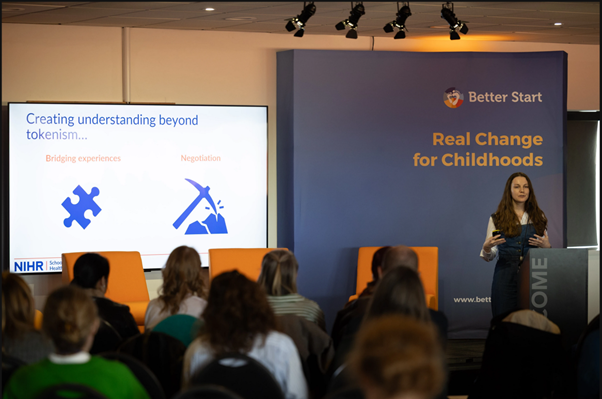
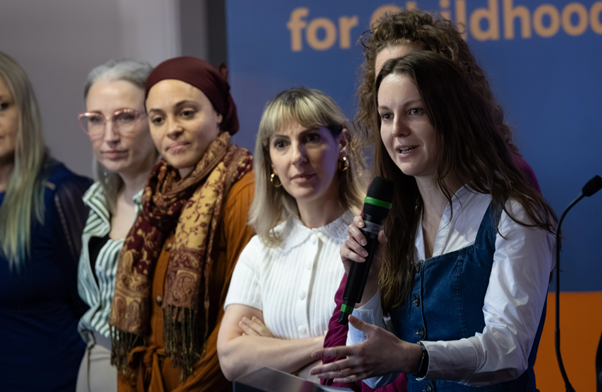
Photos by Better Start
During the conference I shared emerging findings from my PhD research exploring when and why involving disenfranchised parents leads to meaningful change in services. My findings echo many of the key themes of the day, including the most salient; that real systems change is ultimately relational change. My research has drawn on learning from the past 20 years of early years practice and initiatives, from Sure Start to Family Hubs, and crucially from much of the Better Start evidence.
One key insight from my realist review and evaluation is that involvement is often misunderstood as a set of discrete activities such as consultations, focus groups, or parent panels. In reality, the most effective approaches treat involvement as an ongoing way of working, embedded in everyday practice. This requires what some described as ‘authorising environments’ in which organisations create cultures in which practitioners feel able to listen, adapt, and respond to communities rather than simply deliver pre-defined programmes.
This requires time, consistency and relational effort. Practitioners must reach out to communities, build trust, and create spaces where parents feel confident sharing their perspectives. It also requires confronting power imbalances between “professionals” and “service users”. When those boundaries soften and people interact more human-to-human, new forms of equitable partnership become possible.
Moving forward
Perhaps the most sobering reflection of the day was the suggestion that the early years sector does not necessarily suffer from a lack of knowledge. Across decades of initiatives and policy cycles, we have accumulated substantial evidence about what helps families thrive.
The real challenge is learning from that knowledge and acting on it.
As Ben Lewing eloquently argued, doing so requires humility: listening carefully to parents, practitioners and communities. It requires time. Relationships and trust cannot be rushed. And it requires courage, as systems change inevitably involves stepping beyond familiar ways of working.
Leaving Blackpool
As the conference closed, what stayed with me most was the sense that change is already happening, often in small, relational and locally driven ways. Across the country, many are experimenting with new approaches that place families at the heart of early years systems.
The task ahead is not simply to scale programmes, but to nurture the conditions that allow these approaches to flourish: trust, partnership, shared learning and genuine openness to community voice.
If the conversations in Blackpool are anything to go by, there is both the appetite and the collective wisdom to create real, impactful change for families with babies and young children.
If you’d like to learn more about some inspirational projects happening in the early years sector
I highly recommend checking out:
- Building Babies Brains: A ‘pass it on’ community knowledge exchange initiative led by Georgie Marks and Anna Adcock of Action for Children. The project trains community champions to share evidence-based messages about baby brain development with parents in their own networks. Rather than relying solely on formal services, the initiative builds on existing trust within communities.
- Dad Matters: A great project by Home Start dedicated to increasing engagement with and support for Dads.
- Blackpool Council’s Parent Panels: Some of the most passionate speakers of the day, Blackpool Council are doing great work to embed parent voice in their decision making.
- Bremner & Co: Champions of the often-missed importance of nutrition
- Chorus: Providing safe spaces and psychological support for families with children who have faced adverse experiences
Blog by Leah Attwell, SPHERE PhD Student