By Ros Shaw, Sustainability Manager (Biodiversity)
Why are there so many dead bumblebees outside the Forum?
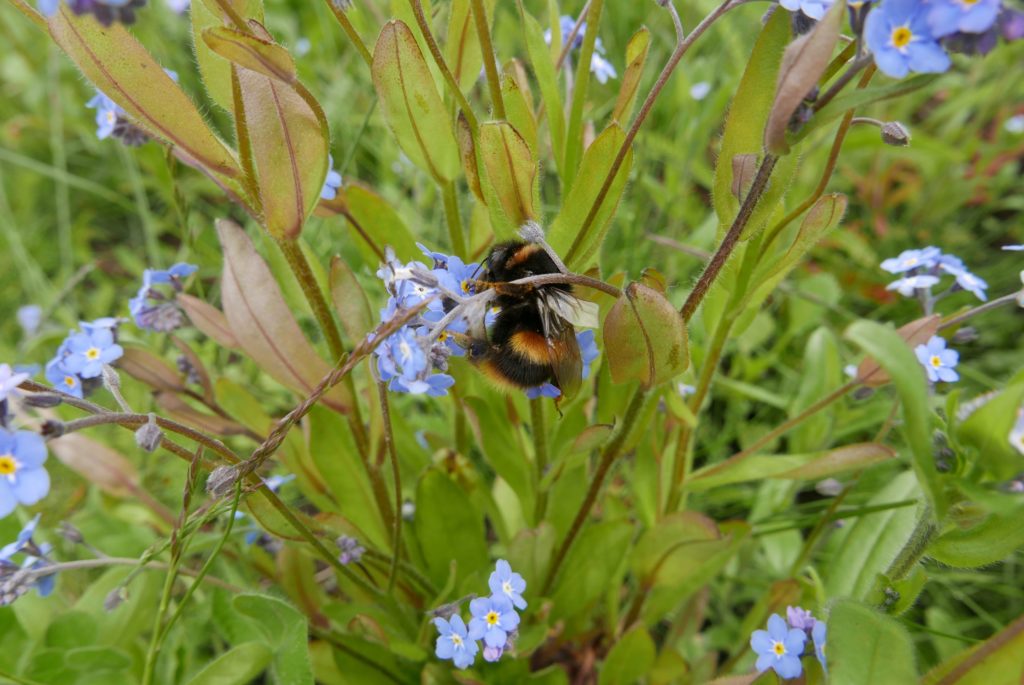
There are two places high up in the Forum roof where bumblebees regularly nest. These are buff-tailed bumblebees, whose nests may be up to 500 bees in a good year! Buff-tailed bumblebees commonly nest underground, but they can also nest in roof spaces. Bumblebees are quite short lived; the workers can live for only a few weeks in spring and summer when flowers are abundant. The only bumblebees that survive to the next year are the mated queens, which hide in the vegetation during winter and hibernate. As the nests come to the natural end of their life, the workers and males will die off.
There may also be some confused bumblebees in this area, as we have some beautiful lime trees. Lime tree nectar has low sugar content, which means that it is not a great food source for bumblebees. It can contain plant chemicals that the bees find addictive so they keep eating lime nectar long after they should stop. This is not well understood, as some bumblebees seem to tolerate lime nectar just fine.
Some years there may be more dead bumblebees than others. This may be for a number of reasons: the nest was particularly successful that year so it was bigger than usual; or they may have been affected by predators, pests or the weather.
For more information see: I’ve found a dead bumblebee – Bumblebee Conservation Trust
What can we do to help protect the bumblebees?
Unfortunately there is little that we can do to prevent this as it is part of their natural life cycle. We also can’t prevent them from using the lime trees for nectar. Preventing the bumblebees from nesting here would mean they don’t have the opportunity to use this area to raise new generations of bumblebees!
Across our campuses we are working to improve habitats for bumblebees by planting pollinator friendly plants, and leaving our grassland areas to grow a bit longer during the summer. This provides wildflowers for food and nesting areas for bumblebees which like to nest in longer grass. We are also monitoring bumblebees using the Bumblebee Conservation Trust’s BeeWalk. This is all part of our Nature Positive Strategy.
We don’t use insecticides on campus, keep herbicide sprays to a minimum. We make sure plants don’t have any flowers on them before spraying herbicides to protect bees from consuming them accidentally.
Are they dangerous?
Bumblebees can sting you, but generally they are not very aggressive when they are not protecting their nest. We recommend that you don’t pick up or touch bumblebees.