

By Rob Court, Product Manager, Digital Skills
The recent Success for All conference brought together colleagues from across the University of Exeter to explore how we can create better experiences for colleagues and students through meaningful, practical change.
As part of the event, I facilitated two round table discussions titled Building Digital Capability for Better Team Outcomes. The sessions focused on how digital confidence and capability can support meaningful change by concentrating on outcomes rather than tools.
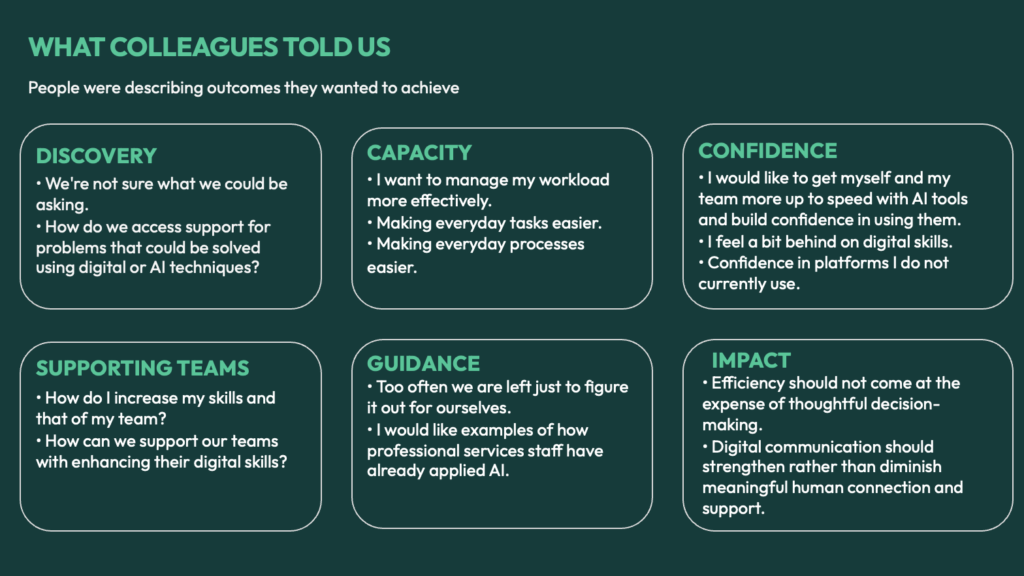
What struck me most was that, although the conversations touched on AI, digital tools and new ways of working, people were rarely talking about technology itself.
Instead, they were talking about outcomes.
They wanted more time. They wanted less frustration. They wanted to reduce repetitive tasks. They wanted to support their teams more effectively. And they wanted to feel confident that they were making a difference.
That observation stayed with me long after the conference ended.
Start with the problem, not the technology
It’s easy to get excited about technology. New AI tools appear almost daily. Organisations invest in new platforms, systems and capabilities. Yet when colleagues sat around the table, very few started by talking about software.
Instead, they described the challenges they were experiencing in their day-to-day roles.
Some were struggling with workload. Others were looking for ways to reduce manual processes. Some wanted to better support colleagues and students. Others simply wanted to know where to begin.
As one attendee, Jess Johnson, reflected afterwards:
“Rob encouraged us to work back from the problem we were trying to solve, which sparked lots of ideas to take back and experiment with.”
That comment perfectly captured the spirit of the discussion.
Rather than asking:
“What tool should I use?”
We explored:
“What outcome am I trying to achieve?”
The difference is subtle, but powerful.
Confidence follows outcomes
One of the recurring themes throughout both sessions was confidence.
People wanted to feel more confident using AI. More confident using digital tools. More confident supporting others through change.
But I left wondering whether we’ve got the sequence wrong. We often talk about building confidence first and hope that change follows. Perhaps confidence is actually the result.
I use AI regularly, not because I’m interested in becoming an AI expert, but because it helps me achieve outcomes that matter to me. Whether that’s reducing time spent on routine tasks, improving the quality of my work, or creating more capacity in my day, the value comes from the outcome, not the tool itself.
The same pattern emerged throughout the round tables.
People weren’t describing a desire for more technology, they were describing a desire for better outcomes.
As I reflected after the event:
The confidence shift was clear in the room after each of the two round table events. We did talk a lot about the art of the possible with specific tools, but the difference was that it was outcome led, not software led. Once colleagues began talking about real challenges, the conversation changed. Ideas started flowing. Experiences were shared. People began connecting possibilities to genuine needs.
Digital capability is about people
The conversations reinforced something that often gets overlooked: digital capability is not really about technology. It is about people.
Technology can help us create capacity, improve services and reduce friction, but only when it is connected to a meaningful outcome. This is especially important in higher education.
When colleagues have the confidence, capability and capacity to thrive in their roles, students benefit too. Colleague experience and student experience are not separate conversations. They are deeply connected. When we make it easier for colleagues to do their best work, everyone benefits.
Creating capacity for change
Another interesting theme was transformation.
Many organisations talk about transformation as though it is something that happens to us. We wait for funding, new systems, programmes or permission.
But meaningful change often starts much smaller.
A team simplifies a process. A colleague experiments with a new approach. A repetitive task is automated. An unnecessary step is removed.
Over time, these small improvements create capacity, confidence and momentum.
The most successful examples discussed during the round tables were not large transformation programmes. They were practical examples of people making things a little better, one step at a time.
And perhaps that’s where real transformation begins – not with a programme, not with a tool. But with somebody deciding that something could be better.
What next?
If there was one takeaway from Success for All, it would be this:
Start with the outcome.
Before exploring technology, ask yourself:
- What is frustrating me today?
- What outcome would make the biggest difference to my role?
- What outcome would make the biggest difference to my team?
- What outcome would improve the experience of the students or colleagues I support?
Once you are clear on the outcome, technology becomes much easier to evaluate.
If you’re not sure where to begin:
- Identify one outcome you’d like to improve.
- Reflect on whether your current digital skills or confidence are holding you back.
- Set aside time to experiment, learn and try something new.
It’s likely that technology will form part of the solution, but the technology isn’t the destination – the outcome is.
To stay up to date with the work across Digital Transformation, UoE colleagues can join our monthly Digital Demo sessions, held on the second Tuesday of every month.