
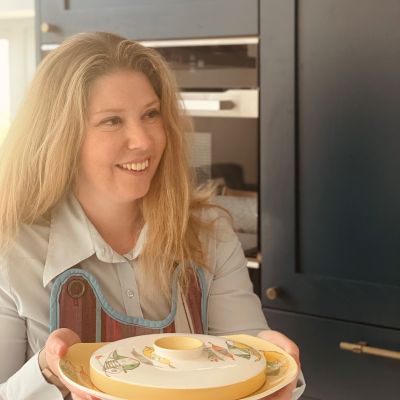
Christine Laessing is a professionally qualified engineer and PhD candidate in Engineering with the Centre for Water Systems, University of Exeter, where her research focuses on adaptive strategies to existing highway drainage to improve absorption and sensor technologies to control pollutant mobilization. Following securing first prize in the STEM category in the Post Graduate Research Poster Competition, part of the Doctoral College’s 2026 Festival of PGR Research, she encourages other PGRs starting out to embrace Exeter Guild’s philosophy of ‘Give it a Go’. She is a mother of two and spends more time thinking about planning parties than actually getting around to hosting them!
The feeling of belonging within a community shapes how we behave within it. With my own position in academia not yet established, I overrode my hesitation to share my proposals alongside my peers with conclusive research. In the spirit of being greater together than the sum of our individual parts, here I compare the collective act of a shared feast to your own agency over how you feel within a group by how much you contribute towards it.
Imagine you are part of a group that has invited contributions to a shared meal at a summer party. In response, messages on the group chat start popping up as you consider your place within this assemblage. With everyone starting to plan their own preparation, this clearly will be a significant event. The invitation prompts you to either accept or decline – yet within either option are further variances of outcome ranging from the poor etiquette of no response, to declining but harrowing yourself with what you would have done, to either accepting with an easy crowd-pleaser or the most exquisite dish containing the most rare and exotic cuisine. Each outcome plots your learned experience to a different point, each in turn may then inform the unknown decisions required in the future.
Exactly how you execute any plan offers strings of decision making, and with that, the exposure required to develop and nurture your capability and confidence, answering a need spanning greater than party food. Experience dictates that the incurred decisions within certain responses can be off-putting, especially if the result may not appear to match the effort. However, I invite you to join me framing this over a longer timespan, and consider your memorable impact at the party as your own inner confidence as a researcher.
Whilst the summer welcomes dining outdoors and prompted this analogy, I’m neither a food writer nor a philosopher. The discipline of Civil Engineering is not especially synonymous with arranging parties, but seriously passionate about getting people to and from them safety, ensuring the festoon lights are twinkling and the drinking water is on tap!
As a first year PGR, I felt no external expectation to participate in the Poster Competition but embraced this as an opportunity to help define the course of my research. That research poster (or well-received dish) is a ticket to initiate a new conversation to test my own perspective and gradually make new space for my research. Beyond that, it was the prospect of being a part of a group event – of contributing to the kaleidoscope of learning pursuits – sharing only that time and location to show the variety of research being undertaken by the University of Exeter and to celebrate how we individually are tackling such a breadth of issues, together. A collection of individuals’ responses to a singular brief celebrates our styles, identity and together informs viewers of the breadth of opportunities at post-graduate level. Much as a ‘bring a plate’ or ‘pot luck party’, such an event or un-curated display of posters is a perfectly unique expression.
The act of creating my research poster helped me feel like I was in control of my approach. I chose a landscape orientation and considered the visual elements of my research and how these could be arranged in a way that would work at different viewing distances. I kept in mind that a poster is a communication tool; part of my new role of learning to be a researcher is learning how to pass on my findings to whom, at the right time. Without wishing to burden my viewers with yet another global problem, I concluded each of my five themes with a takeaway point that offered awareness of positive actions. I designed my poster as if on Supermarket Sweep collecting up all the things I could share about my topic but then hauling most of them out as if I was at the till with a bit of cash, leaving with only the absolute essential things I needed.
Practicing decision making for an audience, develops the way we read and present, just as the planning of a pièce de resistance is a way of bringing yourself to a group is not limited to the development of food preparation skills. Taking the most comfortable option too often snaffles our potential, so be brave – actively seek opportunities to grow your confidence and take your seat at the table!