

Qianqian Li is a second-year PhD candidate in Media and Communication Studies at the University of Exeter’s Department of Communications, Drama and Film. Her research explores the intersection of digital culture, feminism, and social media platforms, with a particular interest in how platform affordances and governance shape feminist activism online. Outside her research, she enjoys travelling, cooking, and photography. Below, she reflects on her experience running a Researcher Led Initiative featuring with external speakers, designed to build connections among PGRs and help them navigate the practical challenges of applying research methods in their own projects.
When I started my PhD, I assumed that learning qualitative research would be straightforward. Read the textbooks, attend the workshops, apply the methods. What I found instead was a gap — not in the availability of methods training, but in how that training connected to the messy, uncertain reality of doing qualitative work with digital media. The textbooks told me how to code interview transcripts. They didn’t tell me what to do when a participant shares something you weren’t expecting, or how to hold your own positionality alongside the data without letting it quietly take over.
That gap is why I applied for a Researcher-Led Initiative award. I wanted to create a space where PGRs could hear directly from researchers working at the intersection of digital culture, gender, and qualitative inquiry — scholars who could speak candidly about how methods actually function in practice. I proposed a four-session seminar series called Qualitative Methods in the Mess, bringing external speakers to Exeter to share their methodological challenges, ethical dilemmas, and reflexive practices.
The reality, of course, was messier than the proposal.
Preparation for the seminar series
Two of the four speakers I had lined up withdrew — one for personal reasons, the other due to scheduling conflicts. Both withdrawals came relatively late, and as a first-year PGR organising an external event for the first time, it was unsettling. I had to decide quickly whether to scramble for replacements or to scale down. I chose to reduce the series to two sessions and invest more depth in each. In hindsight, that was the right call. It let me focus on the quality of the sessions we could deliver rather than spreading myself thin trying to fill gaps at short notice.
Session 1 on the discourse analysis method
Session 1 took place on 5 May 2026 with Dr Altman Peng from the University of Warwick, who joined us in person for a workshop on “Critical Discourse Studies in the Transnational Sinophone digital context”. What struck me, and what several attendees commented on afterwards, was how Dr Altman moved between theory and practice with real fluency, showing us not just how critical discourse analysis works as a framework, but how he applies it step by step on social media. The Q&A was particularly rich: attendees brought questions rooted in their own projects, and Dr Peng responded with genuine engagement. I remember one postdoc in law studies asked about questions related to how to approach national propaganda resorting to CDA. Another PGR asked about how can CDA be applied to interview data given that most of the research using CDA to analyse news discourse. Fifteen PGRs attended, and the informal networking over pizza turned into the kind of cross-disciplinary conversation I had been hoping for lasting from 4pm to 5pm.
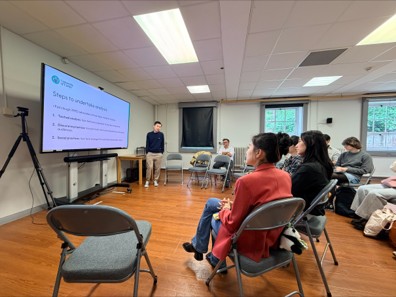
PGR attendees engaging with the workshop on critical discourse analysis.
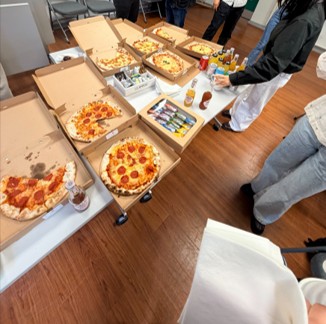
Informal networking over pizza after Session 1.
Session 2 on how to conduct interviews
Session 2 followed the next day, 6 May, with Dr Rikke Amundsen from King’s College London, who led an online workshop titled Interviewing with Intimacy. Her focus was on qualitative interview methods, thematic analysis, and the ethics of researching sensitive topics in digital contexts. What stayed with me most was her framing of vulnerability and trust, not as obstacles to manage, but as constitutive parts of the research relationship. She spoke about what it means to sit with discomfort as a researcher, and how the choices we make about intimacy and distance in interviews shape the knowledge we produce. Twenty-three PGRs attended, making it the larger of the two sessions, and the recording has been made available for those who couldn’t join live.
Learning about IR35 and T1 finance system (order hotel, catering, transportation for others)
As an organiser, I learned things no methodology textbook will teach you. I learned about IR35 compliance checks and T1 payment forms. I learned how to raise a purchase order for hotel accommodation and coordinate catering for fifteen people who may or may not have dietary requirements they forgot to mention. Event planning, it turns out, is an exercise in contingency management, and the ability to adapt when things change is worth more than any amount of advance preparation.
The feedback from attendees was encouraging. Respondents appreciated the focus on real-world methodological complexity, and several asked whether future sessions could cover topics like digital ethnography and visual methods. A small but engaged group of PGRs and ECRs has begun to coalesce around qualitative digital media research at Exeter, which feels like the beginning of something worth sustaining.
Personal reflection
If I were to do this again, I would build more contingency time into the planning — both for speaker withdrawals and for the administrative processes that take longer than you expect. I would also consider hybrid delivery from the outset, since the online session drew significantly more attendees. Most importantly, I would tell any PGR considering an RLI application that the process itself is a form of research training. You learn to plan, negotiate, communicate, promote, and adapt — skills that are just as essential to a PhD as knowing your Foucault from your Fairclough.
I hope this series demonstrated that there is real appetite among PGRs for methodological conversations that go beyond the introductory, and that future initiatives will continue to fill that space.