
This article was first published on Blue Adapt on 28 May 2026
Cara Patel is a second year PHD student in the departments of Sports Science and Public Health (SSPH), Medical School, and European Centre for Environment and Human Health (ECEHH) within Faculty of Health and Life Sciences. Her PhD topic is ‘The Impact of Climate Change on Antimicrobial Resistance’.
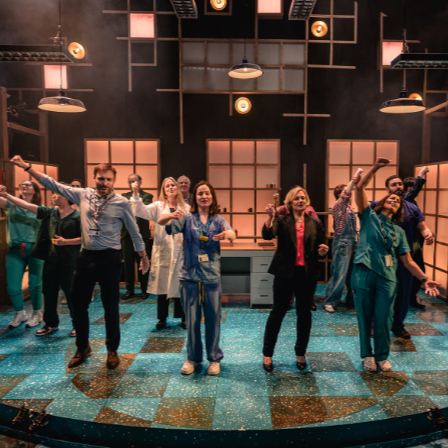
This year I had the absolute privilege to join the chorus of the Off-West End cast of Lifeline. Lifeline is a musical about antibiotic resistance – which on the surface, seems like a pretty weird thing to write a musical about – but it works. The show seamlessly weaves together two storylines that run in parallel; one in the past, following Sir Alexander Fleming as he discovers penicillin, and works to overcome his grief, and the other set in a present-day hospital following a patient that is brought in with a drug-resistant infection.
From its conception, the show has integrated the sciences and the arts, as the writers worked closely with Dr Meghan Perry for advice on the medical themes. What truly marks its dedication to transdisciplinary work is that alongside the main cast of actors, they decided to have the chorus made up of scientists, researchers, and medical professionals linked to antibiotics and antimicrobial resistance (AMR), bringing their real-world knowledge and personal experience to the stage. This was an opportunity to be part of a truly unique project.

What is Antimicrobial Resistance (AMR)?
AMR, also named “the Silent Pandemic” is a global health risk that remains largely unknown to the public, although that is slowly changing. To give a brief summary, it is where an organism can survive and grow in the presence of a substance that once could be used to kill it. When these organisms are pathogens (capable of causing disease), the drugs that were once used to fight it no longer work, and alternative treatments (mostly stronger drugs) are needed.
This aligns with BlueAdapt, as waterways play a significant role in AMR, as they are hotspots for organisms come into contact with pollutants (such as drugs or pollution), as a transport system for these drug-resistant organisms, and this exposed them to humans. My PhD research is on the impact of climate change on drug resistant organisms in the environment, so I was excited to bring my background to the project.
Embracing both arts and science
I have always been both an arts-kid and a sciences-kid, so this project almost seemed made for me. Throughout my childhood, I was told that I would have to pick a lane to have a career, so I chose the sciences. Throughout my PhD however, I discovered about myself that I needed both to be happy and bring my life meaning.
I have spent a long time trying to balance my PhD with my creative endeavours (I joined a choir, I’ve acted in several amdram performances, I run an Etsy shop, I bake novelty cakes, etc), but Lifeline has been the opportunity for me to marry my two worlds.
When I sent off my application to audition, I realised it had been a long time since I had wanted something so badly.
It was around Christmas that I heard back, and it may be the best gift I’ve ever received (apologies mum and dad). That gave me until early-mid January to prepare for the audition (6 minutes to wow the panel). One monologue and a 16-bar cut of a song later and it was over, and it wasn’t long before I heard back that I’d got a spot. Our first rehearsal was only a few days later.
Drugs are in the water, drugs are in the ground
I love the music. I listened to the concept album on Spotify a number of times before my audition. My personal favourite song from the get-go was “I’ve done all that I can”, which is where the title of this article “The Drugs are in the Water, The Drugs are in the Ground” comes from. Despite occurring quite late in the show, I think it represents a real turning point in the story. It is at this point where we zoom out from an insular view of the characters lives to a global issue (AMR) with no one simple solution.
Speaking to some of my friends who came to see me in the show, this song was also their favourite. My friend Dan Carey said, “I loved the fact that it explained the problem without just blaming the government; or saying it was just a them problem”. This song clearly strikes a chord with audiences. The Lifeline team were even asked to perform during the 2024 United Nations General Assembly, making them the only people to perform at the assembly other than Beyonce!

Explaining complex science through song
The lyrics of this song do a fantastic job of highlighting just how complicated the issue of AMR is. Antibiotics and other antimicrobials facilitate our way of life; their continued use and efficacy is necessary to humanity. Additionally, the issue of drug overuse, inappropriate use, and resistance are exacerbated by factors such as lack of clean water, and sanitation, or poor disease control, so some may be tempted to label this as an issue only for ‘developing countries’, but this is truly a global threat.
Current research estimates the death toll at ~5 million globally per year, with that set to rise over time. That is an uncomfortable reality to face, but it is something this song, and Lifeline as a show, handles so well.
The show holds space for that conversation and puts people at the heart of it. This was particularly evident in the finale of the show, where the characters break the fourth wall and allow the chorus members to introduce ourselves and the work that we do to tackle AMR.
My bio was “Hello, my name is Cara Patel, and I am a PhD researcher at the University of Exeter. I look at the impact of climate change on drug resistant organisms in the environment, because the bugs that cause hospital infections don’t just appear in hospitals”. I think the finale grounded the themes of the show in reality and linked the story back to the real science. The take home message became: there are many facets to this problem, but many people are trying to solve it, and the Lifeline chorus, cast, and crew, are a small piece of that.
Despite feeling sadness after my final performance, I found that the overwhelming feeling between us all was hope. Several people voiced the opinion that they no longer felt they were fighting this battle alone, and that being a part of Lifeline gave them hope for the future of tackling AMR.
This musical has ignited us to do more
There have already been discussions on how we as the chorus members can keep the momentum going, from journal articles to community workshops. I think this quote from Dr Babs Kell in the cast group chat sums this up perfectly: “What is so clear to me is that being part of the Lifeline family is igniting us all to do more, bring about change and make a difference”.
For the show itself, their next stages will be organising their next run, which I believe is a national (and possibly international) tour starting 2028. I wish them all the best; and will be following their social media closely to see when auditions get announced.