

When you think of SEO (Search Engine Optimisation), it is all too easy to default to alluring optimisation work: keyword research and application or link-building and PR. But perhaps the most basic and overlooked lever for search performance is brand clarity. With ever-increasing amounts of rubbish on the web – be it scams, AI slop, or just low-value content – prioritising user trust is more important than ever. And with an increasingly diverse array of platforms being used to search, optimising your presence outside of Google is no longer optional.
At the beginning of 2025, we went back to basics and reviewed our presence on Bing from first principles. Through updating our brand appearance, submitting updated sitemaps, and cleaning up years of outdated indexed pages, we increased our web traffic from Bing by 26.5% from 2024 to 2025. The changes were simple, low-effort, and required no major content or technical work. Yet the impact on traffic outcomes was substantial.
Below, we’ll outline the changes we made in detail, why it was so effective, and how other organisations can leverage their brand and apply the same approach.
The Overlooked Role of Brand in SEO
Brand consistency helps search engines and users understand who you are and what you offer. It’s a hallmark of how trustworthy your site is. Getting your branding right has impact across search and discovery, influencing entity recognition, indexation and appearance in results pages, and user trust. All these areas contribute to improving your click-through rate; the number of users who see your link in search results and click.
Issues We Found
During an audit of our presence on Bing, we identified some key issues that were undermining our brand visibility and consistency.
- Our brand name was inconsistent across various sub-domains and results.
- Many of our indexed webpages were displaying HTTP rather than HTTPS results.
- Our favicon (site icon) was incorrect (or missing) in almost all results.
- A significant number of legacy/decommissioned results were displaying.
- Our sitemaps were out of date and not providing Bing with any useful information.
Whilst each of these issues in isolation isn’t critical, together they created an identity crisis for our brand in Bing.
Fixes We Implemented
We implemented a few quick, basic fixes to address some of these issues. We reached out to Bing’s Webmaster Tools team to update our favicon with our new logo. We also submitted updated sitemaps for the entirety of our central website to help Bing understand our current structure and ‘flush’ out legacy results.
We also audited HTTP results, ensuring we had correctly set up 301 (otherwise known as permanent) redirects from HTTP to HTTPS results. In some cases, old HTTP results were not being flushed and updated in Bing’s index as the HTTP version of a page was still available on our server, despite the page being drastically updated since the first result was indexed.
The Result: A 25% Increase in Bing Traffic with No Impressions Growth
We reviewed the results of this work, comparing 6 months of data post-completion with the average of two sets of 6-month segments prior. The results are pretty staggering:
Traffic from Bing rose by approximately 26.5%; from ~405,000 clicks to ~512,000 clicks per period. Impressions remained stagnant across each period at approximately 8.6m per period, meaning click-through rate has improved from 4.7% to 6%.
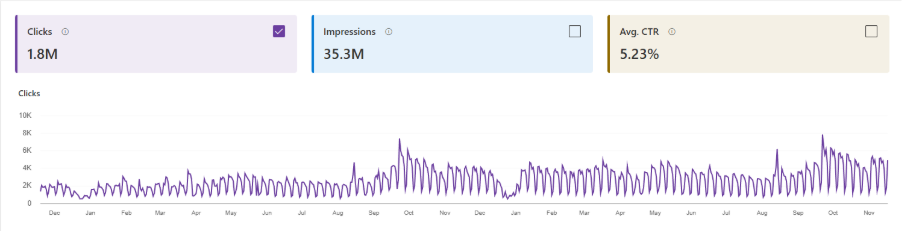
These results were achieved without any new content or campaigns. They were driven by improving user trust through brand clarity directly in search results pages. Not only did we reduce the amount of poor pages shown in results (known as index clutter) and give Bing more consistent metadata to generate results with, but we leveraged the power and recognition of our brand to reassure users that they could trust our website to provide them with the answer to their question.
What You Can Learn
Everyone knows how important SEO is, but many teams underestimate the importance of brand hygiene and its impact on search. The fixes we made are not technically complex and can be fairly described as entry-level SEO work. Yet they can have disproportionate impact, especially for large organisations. Brand coherence is foundational for modern search. Brand matters for SEO, make sure you are leveraging yours.
*Glossary
SEO, or search engine optimization, is the practice of optimising a website to increase its visibility in search engine results, driving more organic (free) traffic to the site. It involves improving a website’s content, structure, and performance to help it rank higher on search engine results pages for relevant user queries.
Brand clarity is the state where a brand’s identity—its purpose, vision, values, and offerings—is clearly understood both internally and externally.
A sitemap is a file that lists a website’s important pages to help search engines understand its structure and how its content is organised.
Bing is a search engine developed by Microsoft.
Entity recognition, is a natural language processing (NLP) technique that identifies and categorises key information in unstructured text into predefined categories like names, locations, organisations, and dates. Its goal is to convert raw text into structured information by identifying meaningful elements, such as distinguishing between the Amazon river and the company Amazon based on the text’s context.
A favicon is a small icon, often a simplified version of a company’s logo, that represents a website. It is displayed in various places, including browser tabs, bookmark lists, the address bar, and search results, to help users quickly identify and navigate between different pages. The term is a combination of “favourite icon” and it functions as an icon for your site’s “favourites”.
Impressions refer to the number of times an ad or organic search result appears on a screen, regardless of whether it was clicked.
Click-through rate (CTR) is the number of users who see your link in search results and click.
Indexation is the process where search engines analyse and store information about web pages in a massive database called an “index”.
HTTPS is the secure, encrypted version of HTTP. HTTPS uses encryption to protect data as it travels between a user’s browser and a website, while HTTP transmits data in plain text, making it vulnerable to interception. Consequently, HTTPS is essential for sensitive data and is used by most modern websites, indicated by a padlock icon in the browser’s address bar.