
The Science
How fire and climate change reshape soil carbon in Amazonian forests
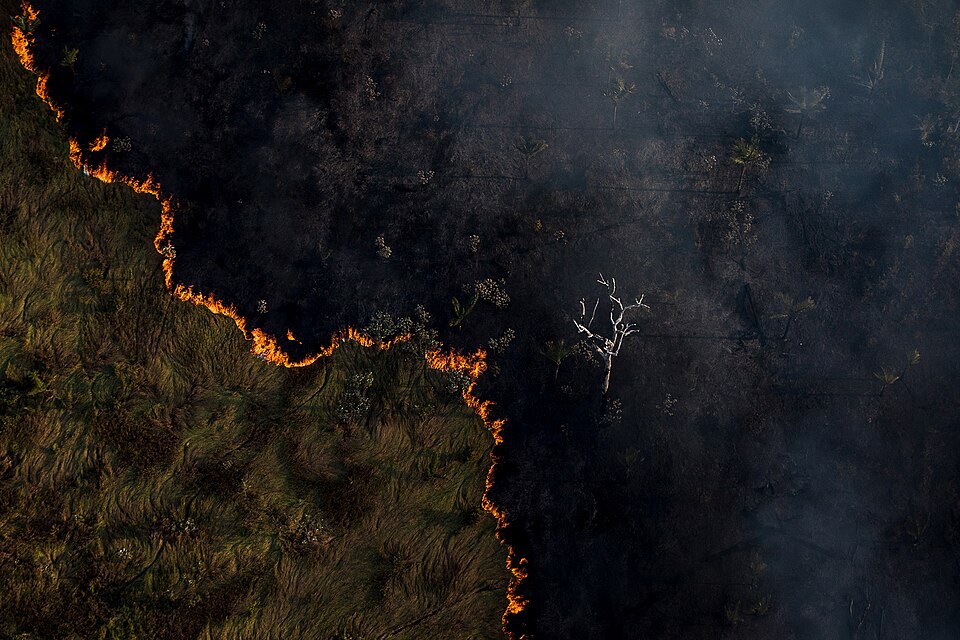
Wildfires are becoming the new normal across Amazonia. The area of Amazonian forest degraded annually (logged and burned but not cleared) now rivals the area outright deforested.
While burning of tropical forests is already releasing more CO₂ than all of Europe’s fossil fuels, the fate of soil carbon has been almost entirely overlooked. Trees in Amazonia hold around seven times the C humans emit annually, and the soils contain the same amount again. Amazon PyroCarbon is the first systematic, pan-Amazonian measurement of what fire does to this hidden pool.
Research objectives
01
Quantify baseline SOC and PyC
Measure soil organic carbon and pyrogenic carbon (charcoal) stocks in intact, old-growth Amazonian forests to establish the baseline before fire exposure.
02
Analyse fire chronosequences
Track how SOC (and its mineral-associated and particulate fractions) changes after fire by studying forests at different times post-fire, from recently burned to long-recovered.
03
Improve the JULES land model
Integrate new PyC processes into the JULES land surface model so climate projections can account for pyrogenic carbon production and stabilisation in Amazonian soils.
04
Inform land management
Provide data-driven recommendations for practices that minimise SOC loss after fire, supporting Brazil’s 2060 carbon neutrality goal and Paris Agreement commitments.
Our approach
We compare Intact Forests (IF) with Human-Modified Forests (HMF) (burned, logged-and-burned, and secondary forests) across an established network of plots along the Amazon “Arc of Deforestation and Degradation.”
By combining intensive field sampling with advanced laboratory analysis (C isotopes, radiocarbon dating, soil fractionation), remote sensing, and land surface modelling via JULES, we are building the first continent-scale picture of how fire reshapes the Amazonian soil carbon pool.
Header image credit: Amazônia Real / Bruno Kelly, CC BY 2.0, via Wikimedia Commons
.jpg)