Research Findings
Fire releases carbon from the trees above, but also unlocks a cascade in the soils below. Our first results show that the belowground story is just as important.
Key findings to date
Based on our published papers. New findings will be added as work progresses.
01
Soil organic carbon response to fire
Repeated burning and agricultural conversion in southern Amazonia drive significant losses in soil organic matter fractions. Depth-resolved analyses show that topsoil carbon is most vulnerable, with labile fractions depleted within one or two burn cycles. However, mineral-associated organic carbon in deeper horizons shows greater resilience, depending on clay content and soil type.
02
Pyrogenic carbon (charcoal) in soils
Peatlands across Amazonia record multi-century wildfire legacies as persistent PyC stocks, with the 20th century showing unprecedented burning intensity compared to the previous two millennia. In montane systems, edaphic and climatic gradients determine how much PyC accumulates and persists, with implications for long-term C sequestration potential under changing fire regimes.
Wang et al. 2026 → Wang et al. 2025 → Montes-Pulido et al. 2025 →
03
Climate extremes, degradation and carbon models
The Amazon’s hottest dry-season days warmed 0.49 °C per decade from 1981 to 2023, more than twice the annual-mean rate, most rapidly in central-north Amazonia, far from the deforestation frontier. Fire-driven degradation reshapes canopy structure and floristic composition across forest–savanna gradients, and Lidar tracks the recovery that follows.
Barlow et al. 2026 → Doyle et al. 2025 → Rocha et al. 2025 →
Publications
Barlow, J., Carvalho, N. S., Nunes, C. A. & Feldpausch, T. R. et al. (2026). Rapid increase of climate extremes reveals new areas of concern in Amazonia. Communications Earth & Environment, 7, 746. doi: 10.1038/s43247-026-03975-1
Depoortere, P., Bauman, D., Fayolle, A., Phillips, O. L. & Feldpausch, T. R. et al. (2026). Region-specific forest structure pathways reveal climate effects on old-growth tropical forest biomass. Scientific Reports, 16, 27381. doi: 10.1038/s41598-026-61888-7
Carreiras, J. M. B., Higginbottom, T., Godlee, J. L. & Feldpausch, T. R. et al. (2026). Determinants of L-band backscatter in dry tropical ecosystems: implications for biomass mapping. Remote Sensing of Environment, 334, 115213. doi: 10.1016/j.rse.2025.115213
Lei, Y., Wei, Z., van Groenigen, K. J. et al. (2026). Soil organic nitrogen rather than fertilizer drives dinitrogen losses in flooded rice systems. Proceedings of the National Academy of Sciences, 123(17), e2603983123. doi: 10.1073/pnas.2603983123
Jiao, Y., Zhu, X., Yu, F., van Groenigen, K. J. et al. (2025). Upcycling trace amounts of biomass waste into flash graphene can boost crop yields by more than a quarter and offer climate benefits. One Earth, 8(10), 101486. doi: 10.1016/j.oneear.2025.101486
Yang, J., Xia, L., van Groenigen, K. J. et al. (2025). Sustained benefits of long-term biochar application for food security and climate change mitigation. Proceedings of the National Academy of Sciences, 122(33), e2509237122. doi: 10.1073/pnas.2509237122
Naval, M. L. M. et al. & Feldpausch, T. R. (2025). Impacts of repeated forest fires and agriculture on soil organic matter and health in southern Amazonia. CATENA, 254, 108924. doi: 10.1016/j.catena.2025.108924
Wang, Y., Gallego-Sala, A., Bird, M. I. & Feldpausch, T. R. et al. (2025). Wildfire legacies on pyrogenic carbon stocks in Amazonian peatlands. Communications Earth & Environment, 6, 678. doi: 10.1038/s43247-025-02674-7
Vedovato, L. B., Aragão, L. E. O. C. & Feldpausch, T. R. et al. (2025). Impacts of fire on canopy structure and its resilience depend on successional stage in Amazonian secondary forests. Remote Sensing in Ecology and Conservation, rse2.431. doi: 10.1002/rse2.431
Pereira, M. B., Elias, F., Teixeira, N. D. A., Feldpausch, T. R., Marimon-Junior, B. H., & Marimon, B. S. (2025). Post-fire changes in tree diversity, composition and carbon in seasonal forests in the Southern Amazonia. Forest Ecology and Management, 578, 122447. doi: 10.1016/j.foreco.2024.122447
Alvarez, F., Marimon-Junior, B. H., Marimon, B. S., Ter Steege, H., Phillips, O. L. & Feldpausch, T. R. et al. (2025). Tree species hyperdominance and rarity in the South American Cerrado. Communications Biology, 8, 695. doi: 10.1038/s42003-025-07623-w
Wang, Y., Feldpausch, T. R., Swindles, G. T., Moss, P. T., McGowan, H. A., Sim, T. E. & Gallego-Sala, A. V. (2026). Unprecedented burning in tropical peatlands during the 20th century compared to the previous two millennia. Global Change Biology, 32(3). doi: 10.1111/gcb.70717
Montes-Pulido, C. R., Bird, M., da Silva Carvalho, L., Serrano, J. C., Quesada, C. A. & Feldpausch, T. R. (2025). Climatic and edaphic drivers of soil organic carbon and pyrogenic carbon stocks across elevation and land-use gradients. Global Change Biology, 31(7). doi: 10.1111/gcb.70135
Doyle, E. J., Graham, H. A., Boulton, C. A., Lenton, T. M., Feldpausch, T. R. & Cunliffe, A. M. (2025). Evaluating GEDI for quantifying forest structure across a gradient of degradation in Amazonia. Environmental Research Letters, 20(5), 054016. doi: 10.1088/1748-9326/adc752
Additional papers are in preparation. Follow our news page for announcements.
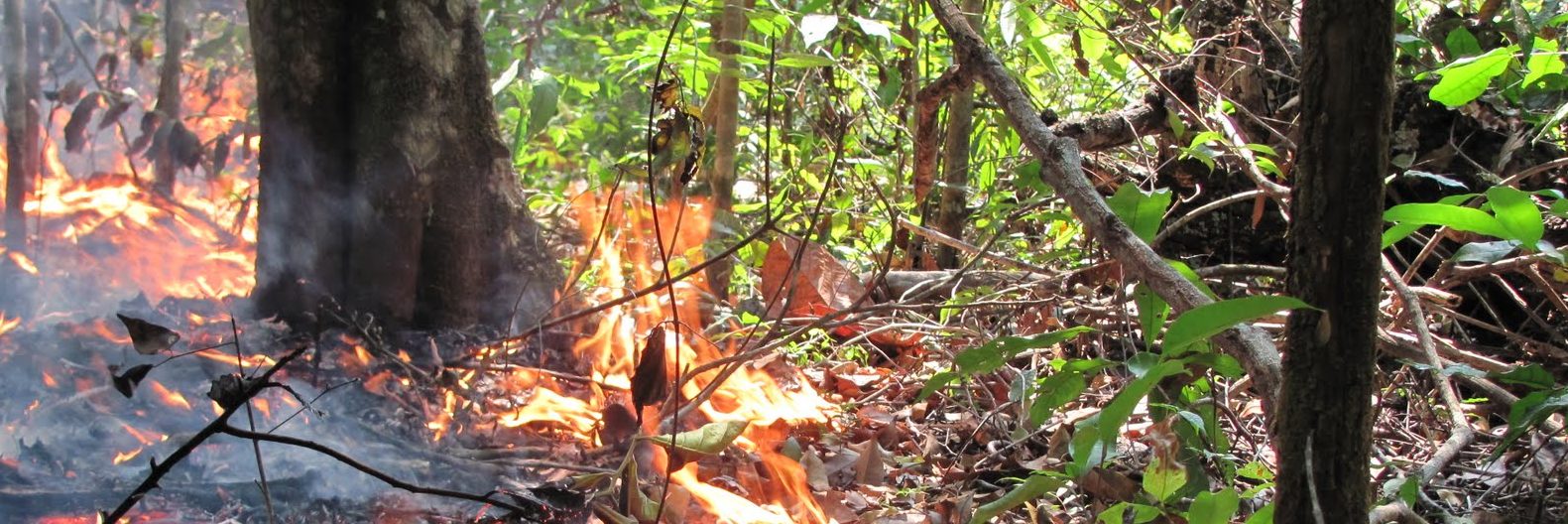
Header image: Paulo Brando