
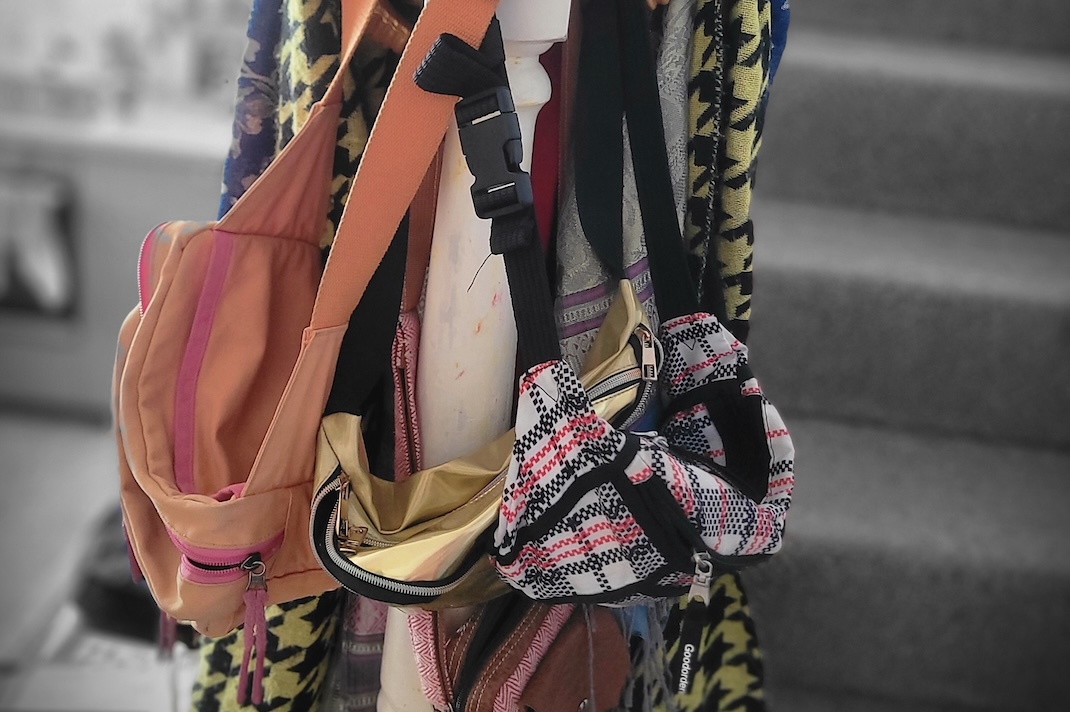
‘The elevation of the “toolkit” frames challenges as machines to be fixed, rather than bodies to be tended.’ Caleb Parkin – a practice-based PhD researcher in Creative Writing with RENEW Biodiversity – reflects on the ways we carry around our research tools (and clean-up kits).
On a boat party once around Bristol Harbour, I asked my friends what was in their huge handbags. There was the usual – tissues, lip balm, tampons – but dredging deeper revealed a small tin of WD-40 and a tiny Buddha statue. Who knows what else arrives, day to day, week to week, the accumulation of objects for earthly survival.
Neither of my friends were carrying a large black & yellow Stanley toolbox (although both, I am sure, had them in their lofts, or garages). Toolkits are for when things need fixing and repair; handbags are for when people need tending and care.
There has and continues to be a profusion of research “toolkits” in academia. I guess it’s code for “applicable” and “practical”, a research outcome with real-world Impact (capital “I”) to reach people beyond the red bricks. In some ways, I love this. I want knowledge to be applicable day-to-day, for whoever might find it helpful. I’d love for my work to reach practitioners of poetry, of teaching and facilitating, of being in the world together. But that doesn’t always involve a spanner. It just as often involves some hand sanitiser and eyeliner.
On nights out or at festivals, my friend and I like to refer to ourselves as Rave Mother (me) and Rave Daddy (her), because we both come prepared. Our bumbags have all that people might need. Got dry eyes? I got the drops. Need some lip balm? What kind? Forgot your shades? I’ve probably got some spares. The “tools” of living day-to-day tend the body’s messy needs of making ourselves comfortable, or beautiful.
In the queer community and in queer nightspots, this can be up front and centre. In Bristol’s more thoughtful clubland, or the better non-corporate festivals, there are welfare spaces in which you can get these needs met in a spirit of care. I’m reminded, too, of Ivan Ilich’s “Tools for Conviviality1“, in which he reframes the term not only as telephones or bicycles, but also immaterial tools like spoken language which aid con-viviality, living well together. Toolkits, handbags, bumbags, backpacks. Just as each object has ‘affordances’ – a mirror for reflecting, a wipe for cleaning up (& throwing away) the body’s excretion – each kind of container has its own possible actions, too.
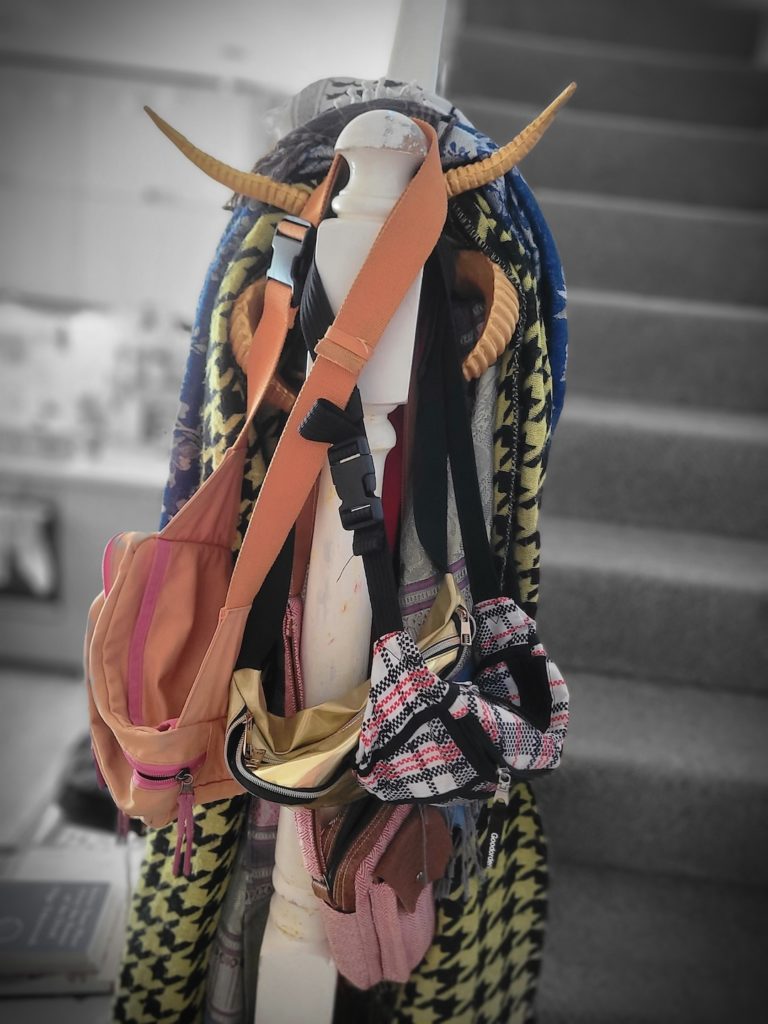
In educational institutions, some people’s handbags, bumbags and rucksacks feel lighter, because the institution was designed around particular bodies and perceived norms. More marginalised people’s experience might lead to them ‘carry’ more, accumulating each day. For people who don’t align with the illusory and universal norms, educational spaces don’t always feel light. The backpacks of, for example, queer, disabled, people of colour, even women (who comprise more than half the world’s population) are carrying more. When the institutions we/they exist within, or in spite of, continually put up barriers to conviviality and joyful participation, backpacks feel heavier. As well as the usual paraphernalia, we carry shame, frustration, rage. But we often also carry the “tools” to tend ourselves & care for one another. Not that we should have additional labour, but in the context of nights out or boat parties, co-caring is a joy, not a duty, or chore.
Speaking of “chores”, can you imagine if there was a “research cleaning caddy”? How might that represent the research being carried out & its applications of “cleaning up”? There’s plenty of that to do, but dominant narratives often do not value the people who do the clearing up, instead venerating the singular genius with a shiny techno-fix instead. The elevation of the toolkit is part of this aesthetic, one which frames the “problem” is a machine to be fixed, rather than a body to be tended, or a home to be returned to habitability. The domestic labours of care and the co-caring (as we sometimes witness in queer nightlife) aren’t seen as part of the solution.
I’ve been reading Cathy Mazak’s very helpful ‘Making Time to Write: How to Resist the Patriarchy and Take Control of Your Academic Career Through Writing‘ lately. I find its emphasis hugely refreshing: centring writing at the same time as acknowledging duties of care for others and self-care.2 Mazak uses “pipeline” as an image throughout, in relation to publications-in-process. To me (no shade, Cathy, you’re great) this image is deeply embedded in industrial, fossil fuel-oriented productivity. Even though the book is in many ways resisting that, it’s still attempting to do so in hyper-capitalist US culture). What kinds of embodied, organic, ecological imagery might adjust the ways we see this process? For me, mycelium and fruiting bodies feel congruent, or the circumnutation of climbing plant tendrils, which leads, perhaps, to bougainvillea or clematis flowers. I’m not against technology, far from it, but I think its language has infiltrated academia to the extent we think of ourselves, research, and sometimes even the research beneficiaries as machines.
That time is not yet upon us, despite the best efforts of the broligarchy. And even if the future is transhuman and cyborg, who knows – instead of moving ourselves into the hard language of tools, what if we moved the academic engine into the soft, messy language of ecology, care and bodies? We can still acknowledge the darker, more gothic, potential of all of these. But if you’re creating a research ‘output’ – wait, while we’re at it, let’s rethink that term too – a research toadstool, let’s say. If you’re creating something for others to put to use, then perhaps it =isn’t metal and sharp-cornered, but grown, or stitched together, with a pocket for the lip-balm, the WD-40 (because machines need tending too), and even that tiny Buddha. I’m pretty sure that, like any and all enlightened beings, he’d approve of taking care of our muddled togetherness, rather than trying to bash it back into shape with a wrench.
1 Illich, Ivan, Tools for Conviviality, Harper Row, 1973
2 Mazak, Cathy, Making Time to Write, Morgan James, 2022

Caleb Parkin’s poems have appeared in The Guardian, The Rialto, and The Poetry Review and was guest poet on BBC Radio 4’s Poetry Please. He won second prize in the National Poetry Competition 2016, first in the Winchester Poetry Prize 2017 and various other shortlists.
His latest collection is Mingle, 2024. His debut collection, This Fruiting Body, is published by Nine Arches Press and was longlisted for the Laurel Prize 2022. He’s published three pamphlets: ‘Wasted Rainbow’ with tall-lighthouse; ‘All the Cancelled Parties’, his collected City Poet commissions from 2020 – 22; and most recently, ‘The Coin’ with Broken Sleep Books.
He has tutored for Poetry Society, Poetry School, Cheltenham Festivals, First Story, Arvon, and holds an MSc in Creative Writing for Therapeutic Purposes (CWTP).