
Posted by Ted Feldpausch
20 August 2026Tropical forest carbon accounting concentrates on trees. In the Colombian Andes, that is the smaller half of the story. Across 36 plots spanning 176 to 3,139 m elevation, soil organic carbon rises six-fold with altitude, from 121 Mg C ha−1 in the Low Andes to 772 Mg C ha−1 in the High Andes, measured to 1 m depth. One hectare of high-Andean forest soil holds more carbon than six hectares of lowland forest soil.
A new policy brief distils this research for policymakers, carbon standard bodies, and project developers, and sets out what it means for conservation finance in the region.
The brief makes three: include locally calibrated soil carbon baselines to 1 m depth, not just 0–30 cm, in Andean conservation and restoration projects; recognise the pyrogenic fraction as evidence of permanence by measuring carbon fractions rather than bulk totals alone; and prioritise high-elevation Andean forests in conservation finance and land-use planning, where each protected hectare locks away the most carbon.
Read the full policy brief below:
This brief pairs with Amazon Soil Carbon: The Missing Credit, which quantifies what fire and agricultural conversion cost the soil in lowland Amazonia. Together they cover both sides of the question: what disturbance takes from the soil, and what stays behind.
Reference:
Montes-Pulido, C. R., Bird, M. I., da Silva Carvalho, L. C., Serrano, J., Quesada, C. A., & Feldpausch, T. R. (2025). Climatic and edaphic drivers of soil organic carbon and pyrogenic carbon stocks across elevation and disturbance gradients in Colombian Andean forests. Global Change Biology, 31(7), e70135. https://doi.org/10.1111/gcb.70135
Research supported by the Natural Environment Research Council and Arts and Humanities Research Council under the Newton-Caldas Colombia Bio programme (NE/R017980/1) and NERC (NE/N011570/1), with support from the Universidad Nacional Abierta y a Distancia (UNAD).
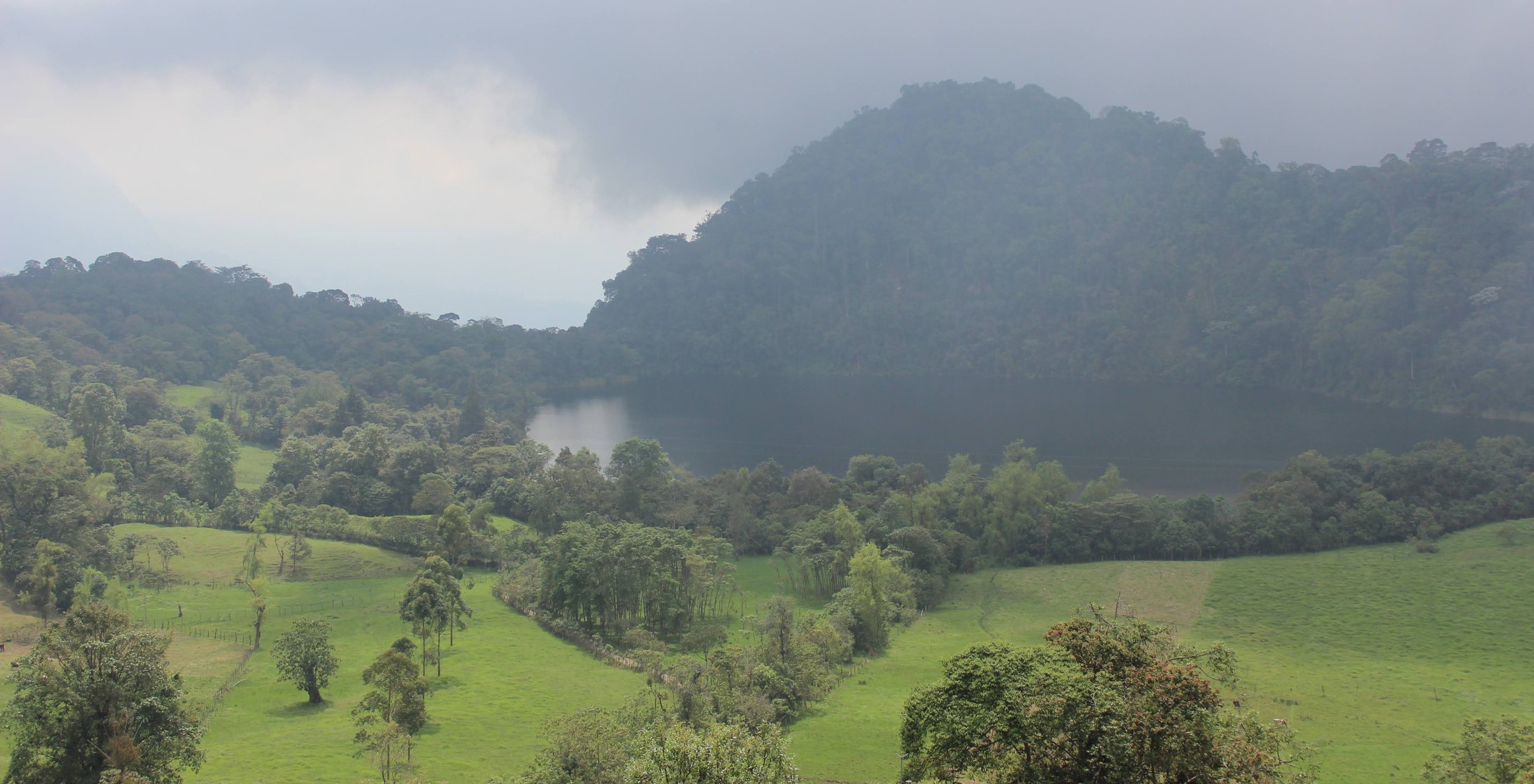
Header image photo credit (Ted Feldpausch): forest and pasture across the Colombian Andes, where soil carbon stocks rise six-fold with elevation.