
Posted by Ted Feldpausch
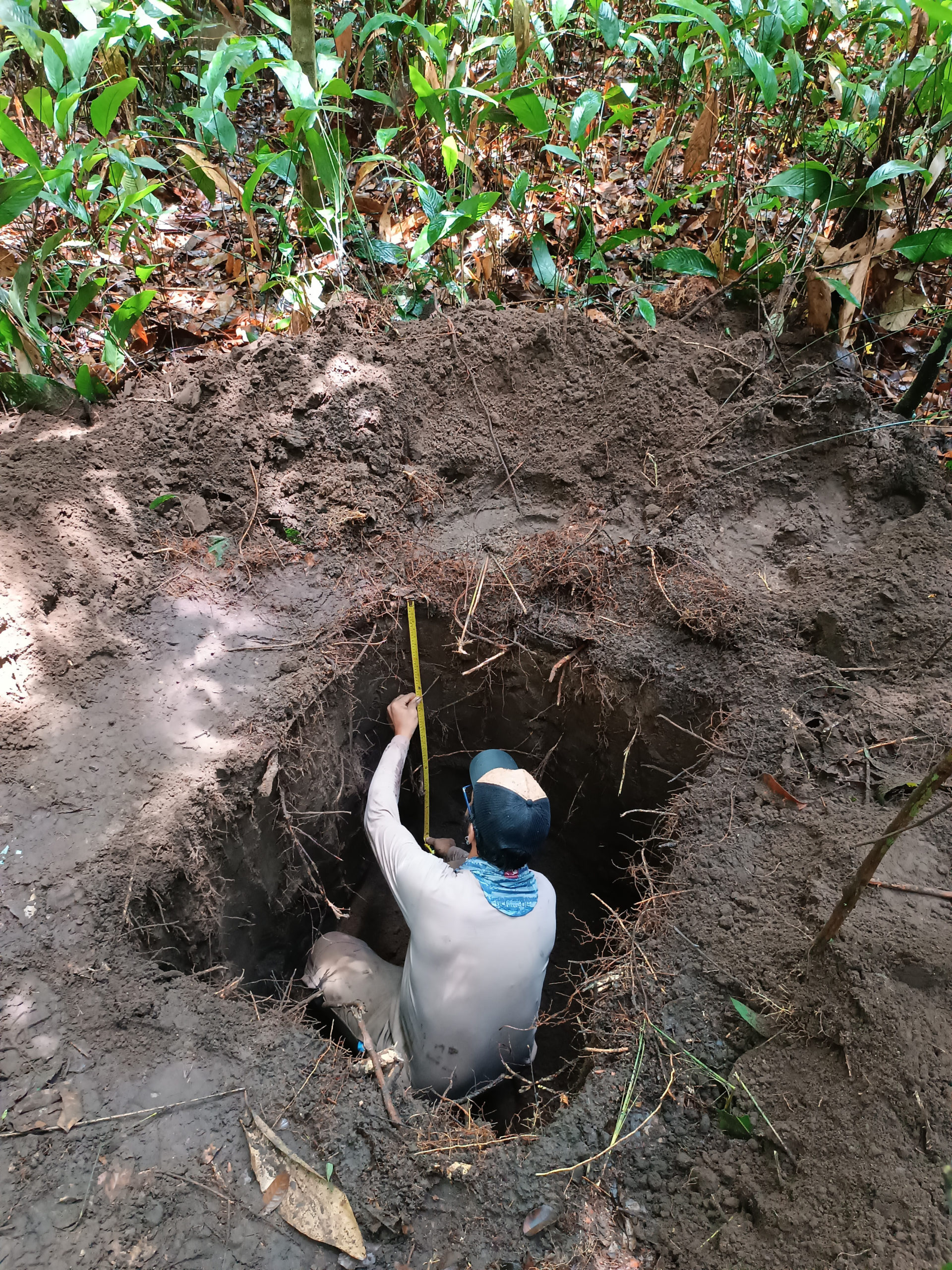
8 August 2017Forests across the Amazon Basin that have no known history of fire still hold the carbon left by fires long past. About one tenth of the carbon in their soils is pyrogenic carbon, the charcoal-like residue of burning, and half of it lies more than half a metre below the surface.
These are the findings of the first field-based estimate of pyrogenic carbon across the Amazon Basin, led by Nina Koele at the Universidade do Estado de Mato Grosso (UNEMAT) with Ted Feldpausch at the University of Exeter and partners at James Cook University, the University of Leeds and INPA.
Fire is becoming more frequent across the Amazon. To understand what fire does to forest soils today, and what deforestation puts at risk, we first need to know how much fire-derived carbon the soils already contain and where it sits. This study provides that baseline. Because so much of the store lies below the depths that inventories and carbon projects usually measure, it is largely invisible to the accounts used to manage soil carbon.
The study also sets out a practical sampling design: three samples per hectare are enough to capture the variation within a plot, while sampling to 1 m rather than 30 cm is what it takes to capture more than half of the pyrogenic carbon in a 2 m profile.
Koele, N., Bird, M., Haig, J., Marimon, B.H., Marimon, B.S., Phillips, O.L., de Oliveira, E.A., Quesada, C.A. & Feldpausch, T.R. (2017) Amazon Basin forest pyrogenic carbon stocks: first estimate of deep storage. Geoderma 306: 237–243. doi.org/10.1016/j.geoderma.2017.07.029 (open access)
We distilled the study for soil inventory agencies, carbon standard bodies and carbon modellers. It makes three recommendations: sample soil carbon to at least 1 m, with three samples per hectare; measure the pyrogenic fraction rather than assuming a fixed 1% share; and represent pyrogenic carbon in models as its own slow pool, to depth.
Read the full policy brief below:
See also the companion brief on the fire history of the same forests: Amazon forest fire: rare for millennia, absent for 800 years.
Funding: CAPES Science without Borders (PVE 177/2012), NERC (NE/N011570/1), CNPq (PELD 403725/2012-7; PPBio 457602/2012-0) and the University of Exeter.
Header photo: © Amauri Barradas. Sampling a deep soil profile under intact Amazon forest.