
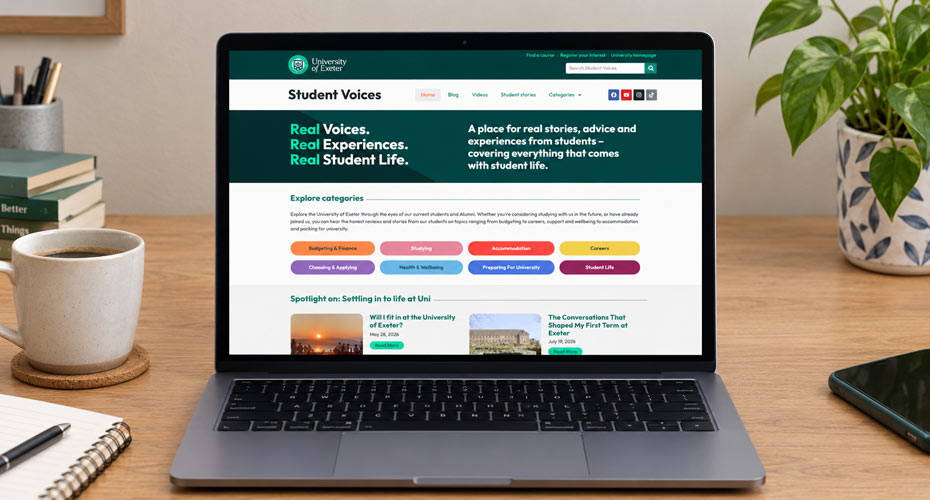
Earlier this year, the Campaigns team in External Engagement and Global came to us with an idea: to create a dedicated space online where prospective students could find authentic stories and insights from current University of Exeter students.
We already had students generating content about life as an Exeter student in a variety of ways:
- Student Bloggers – writing posts on a range of topics, from Freshers Week through to preparing for life after university. The blog has been active for over a decade!
- Student Vloggers – students sharing their experiences through video, published on our YouTube channel.
- Student Stories – profiles and stories gathered by the Campaigns team.
The challenge was to bring all of this content together into one experience that made sense to prospective students, rather than making them navigate three separate sources.
The result is the Student Voices Hub: a single platform to give prospective students an authentic view of life at Exeter.
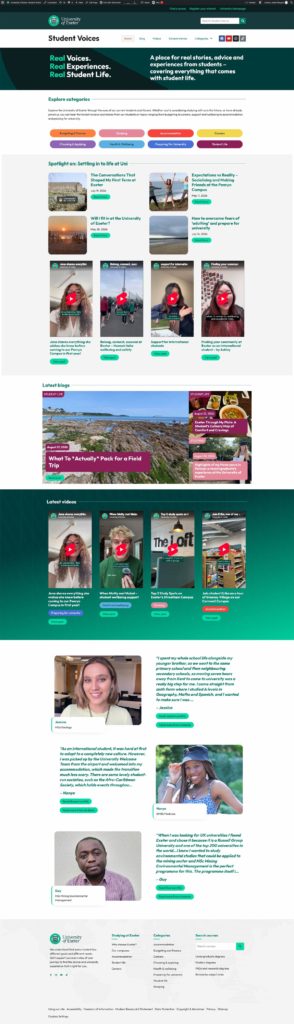
Student Voices in numbers:
420 Blog posts
47 Video blogs
55 Student stories
8 Categories
39 Topics
20+ Website feeds
24k Page views*
1400 Visitors*
*First week since launch
Using categories and tags to connect content
One of the biggest challenges was making the Hub feel like one joined-up service when it contained different types of content.
So rather than organise content just around around content type, the solution was to also organise content around topics related to different aspects of student life at Exeter, such as careers, accommodation and studying.
This gave us a way of connecting related content, regardless of its format.

Why WordPress?
The existing Student Blog was already built in WordPress and had its own tagging system.
However, over several years the system had grown to more than 700 categories and tags, making it difficult to manage and difficult for users to navigate.
As part of the new build, we took the opportunity to simplify this. After migrating the entire Student Blog to the new platform, we reviewed and consolidated the existing topics and settled on:
- 8 main categories – the broad themes that act as the main content buckets. Every post has to sit in one of these main categories.
- Around 40 tags – more specific topics that allow content to be connected in greater detail.
This gives us a much simpler and more consistent structure.
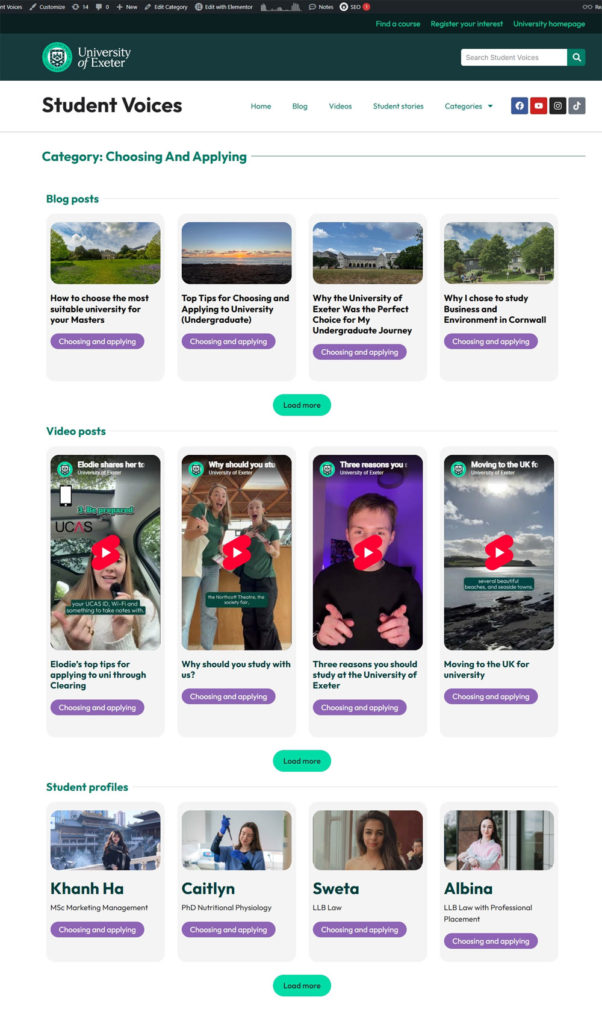
Category pages
Each of the eight main categories has its own colour, creating a visual starting point for visitors exploring the Hub. Wherever a panel linking to a post appears across the Hub, it’s accompanied by it’s coloured category label.
Category pages display the latest content from all three sources in that category – blogs, videos and student stories.
Sidebar content
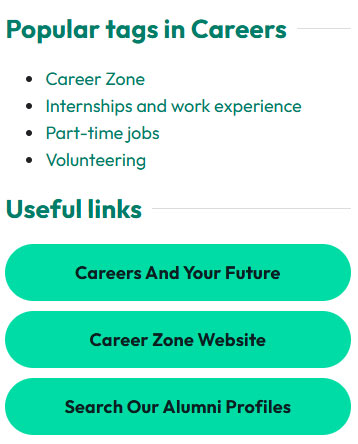
WordPress allows us to add bespoke content to the sidebar of each category.
For example, when a visitor views a post in the Careers category the sidebar shows careers-related tags, alongside links to relevant University content such as the Career Zone and Alumni profiles.
This means the category sidebars also act as gateways into relevant parts of the University website, helping prospective students explore Exeter’s offer in more detail.
Connecting content through tags
Tags provide another way for users to explore the Hub.
At the bottom of each post, users can see up to five tags related to its content.

Clicking these takes the user to a page containing the latest content associated with that topic, again mixing blogs, videos and student stories.
Where categories are the broader topic areas, tags are more detailed, creating connections between pieces of content that previously existed separately.
The current tags are:
A day/week in the life
Budgeting tips
Career Zone
Christmas
Clearing
Clubs and societies
Day trips from Exeter
Exploring Cornwall
Exploring Exeter
Festivals and events
Field trips
Food and drink
Freshers Week
International students
Internships and work experience
Making friends
Mature student
Mental health
Nightlife in Cornwall
Nightlife in Exeter
Open days
Part-time jobs
Penryn Campus
Penryn Campus Alumni
Postgraduate study
Safety
Scholarships and bursaries
Settling in
Shopping
Sport
St Luke’s Campus
Streatham Campus
Student support
Study abroad
Studying tips
Sustainability
The Business School
Undergraduate study
Volunteering
The WordPress dashboard allows us to see which are the most and least populated tags, providing a helpful view of which content areas we need to enhance on the Hub.
Bringing Student Voices into the main website
One of the most useful aspects of the new structure is that the content doesn’t have to stay within the Student Voices Hub.
Because the content is organised using consistent categories and tags, we can pull live feeds of relevant content directly into pages across the main University website.
For example, our page introducing student life in Cornwall includes a feed of content tagged Exploring Cornwall.
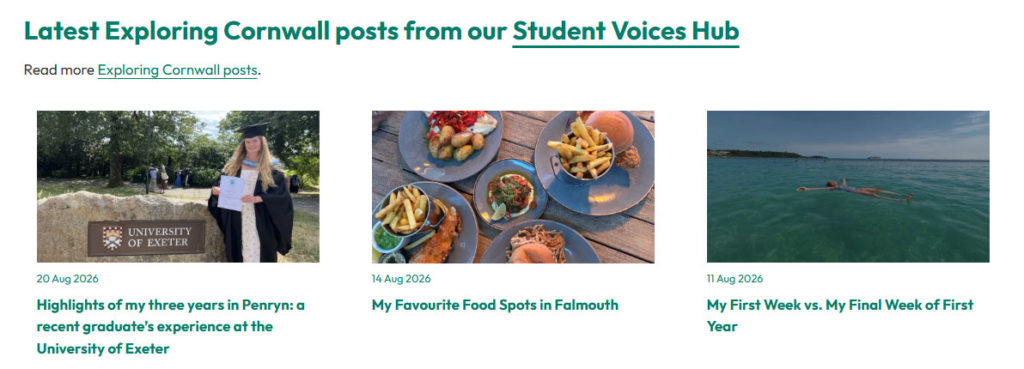
The feed automatically displays the latest relevant posts, including their featured images. No additional CMS update is needed.
We’ve now set up more than 20 feeds across the website, covering topics including:
- Student life
- Settling in as a new student
- Funding and scholarships
- Careers
- Day trips in Devon and Cornwall
- Study tips
And many more!
Helping prospective students find authentic content
Student generated content gives us an opportunity to cover topics in much greater depth than we would normally be able to on the main University website.
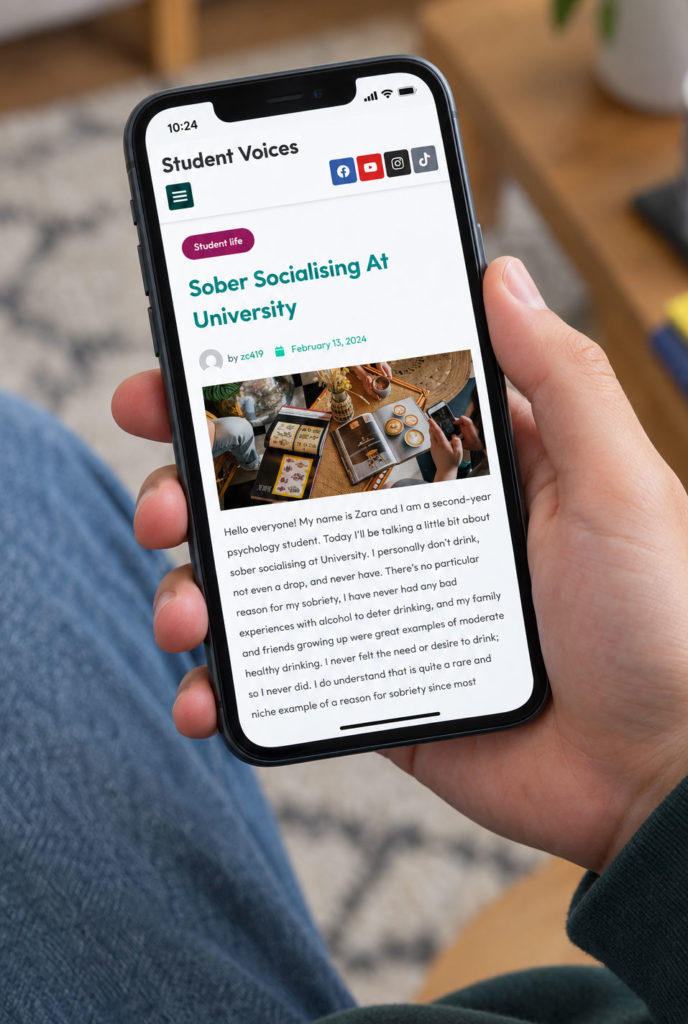
Individual student blog posts can answer very specific questions and provide first-hand experiences of university life. Some examples of posts that received a lot of traffic since launch are:
- Sober Socialising at University
- My Favourite Day Trips from Exeter
- Students’ guide to Societies – Penryn campus
- Freshers’ Week and Term One: What NOT To Worry About
- Exeter Through My Plate: A Student’s Culinary Map of Comfort and Cravings
These are detailed, student-led answers to the kinds of questions prospective students may be asking when researching university. This can also help the content perform better in search engines.
What’s next?
The Student Voices Hub gives us a central home for student-generated content, but its value goes beyond the Hub itself.
By creating a consistent structure around categories and tags, we can connect student content together, surface it in relevant places across the University website and keep those feeds up to date automatically.
It also gives prospective students more opportunities to hear directly from people who are experiencing university life right now.
The next challenge is making the most of the platform: continuing to build the content library, understanding which topics students are looking for and using the data to identify where student voices can add the most value across the wider website.
If you have any questions about this project, please get in touch with us at digitalteam@exeter.ac.uk