
Joel Griffett looks back on negotiating voice and audience while on the trail of a renowned Cornish inventor in Latin America
Joel, many congratulations on recently completing your MRes with the Institute of Cornish Studies. For the sake of any readers who aren’t familiar – who was Richard Trevithick?
He was a Cornish miner, engineer and inventor who lived from 1771-1833. He was a pioneer of high-pressure steam engines, mainly for use in draining water from mines, but they were so versatile that they had countless other uses. He is perhaps most well-known for inventing the first locomotive, tested in 1804 near Merthyr Tydfil, 20 years before the locomotives of George Stephenson, who is often referred to as ‘father of the railways.’
Some of those steam engines were built and imported to Peru to drain the silver mines of Cerro de Pasco in 1815. Trevithick arrived in Peru in February 1817 at the company’s request, as he was the only one who truly knew how to fix them.
What drew you to the idea of going on the trail – in research and in real life – of Trevithick in Latin America?
What interested me most about Trevithick was not his inventions or his locomotives but instead the enormous eleven-year gap in his life between 1816 and 1827 when he went off to Latin America and basically disappeared. All his biographers skipped over this adventure in a sparse chapter or two, yet the scope was astonishing. He went over to work the mines and instead encountered South American liberators and revolutionary wars, undertook jungle expeditions, and made and lost huge fortunes from gold and silver in countries like Peru and Costa Rica.
I knew I wanted to start writing books and I was looking for a truly original idea. I had been teaching myself Spanish and had already considered going to Latin America, but I wanted to travel with a purpose. It all fell into place rather nicely; none of the historians I spoke to could offer me further information on ‘the lost years’ of Trevithick, so I booked a one-way ticket to Chile in September 2022 with the sole intention of finding out what actually happened to him. In total I have done six different trips since September 2022, travelling and researching in Chile, Bolivia, Peru (twice), Colombia, Costa Rica (twice), Guatemala, the USA and Spain. Frankly, I cannot imagine doing anything else.
Tell us about a stand-out memory from one of your field trips.
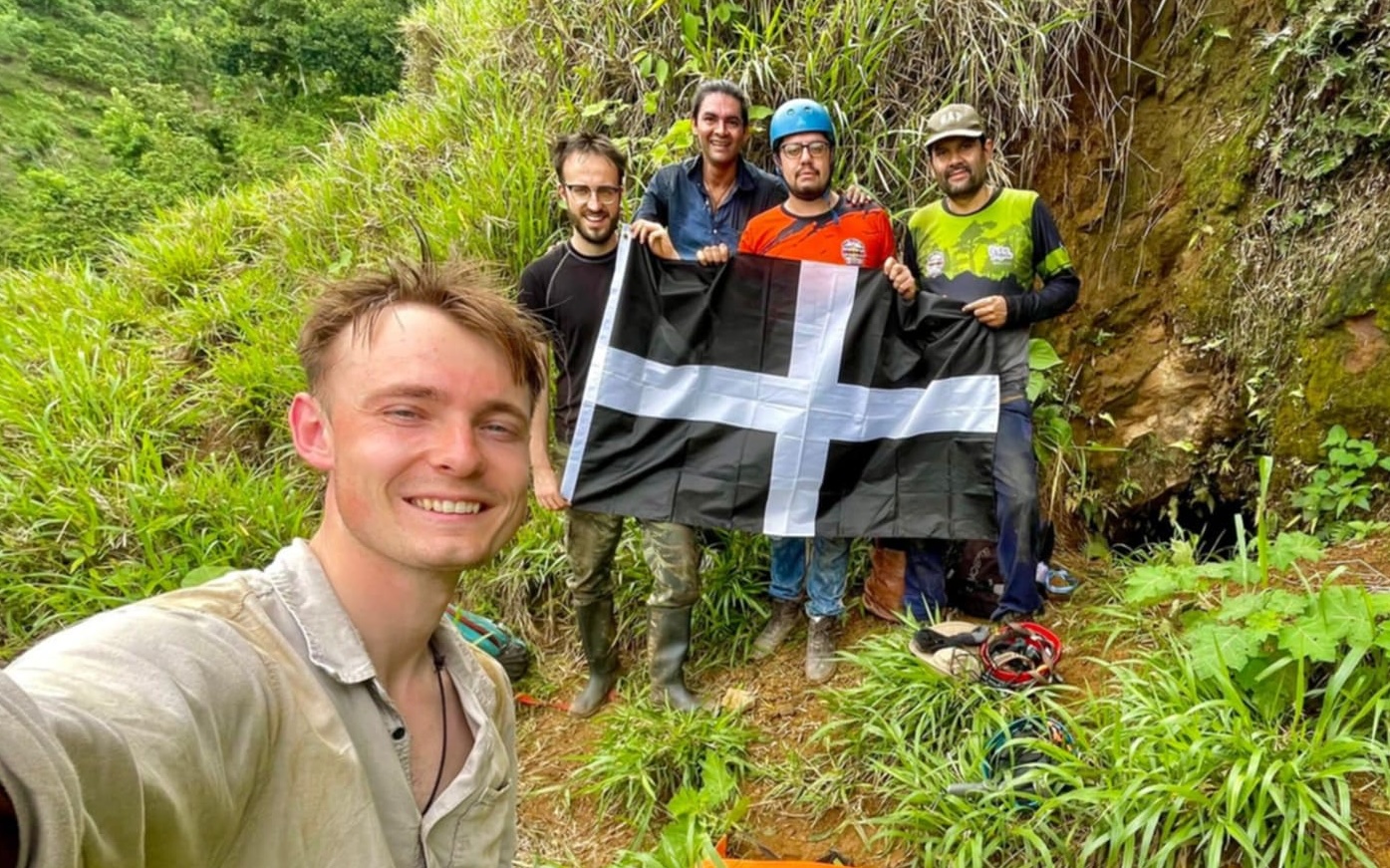
It has to be discovering Trevithick’s lost gold mine in the Aguacate region of Costa Rica last May. I found the claim he made to it in January 1825 in the National Archive of Costa Rica, as well as various maps showing a mine called ‘Don Ricardo’ later in the century. It was named in his honour by other Cornish miners later in the century. From there, my friend, a fellow mining historian, and I visited the abandoned mine itself with a group of local mineral collectors.
Having spent so long looking for any physical remnants left of a man often so elusive, especially in Peru, it was a truly special moment. I was walking literally in his footsteps, inside a mine he discovered and worked, in a country so far away. On my windowsill at home sits a chunk of quartz from the mine. Those tiny flecks of gold within it are a constant reminder of my own adventure in search of Trevithick.
(The featured image for this article is fellow adventurer Ben Sumpter (foreground) with Joel and local mineral collectors by the entrance to the gold mine.)
You blogged extensively throughout your research – did your travelogue writing influence the voice you used in your MRes thesis?
Quite the opposite; they are completely different styles of writing and never the twain shall meet unfortunately (not as an academic at least). It took me at least a year to understand how to write like a historian and the process is ongoing. The travelogues are pure catharsis for me. As much as I have grown to love writing like a historian, it does not bring me the same peace of mind. It often feels dispassionate to write like a historian, but one thing I have deliberately carried over from the travelogues is a literary sensibility that is found wanting in many academic texts. I found George Orwell’s essay ‘Politics and the English Language’ is a very useful guide for navigating this switch in my mind. It is fantastic advice on how to write seriously but always in a direct and succinct way.
The humorously cynical tone of my first-person narrative books is an unwelcome style in academia, but it slipped out on a few occasions. Those passages, often just a sentence or a specific choice of word, have been highlighted in several drafts and in the feedback from the submitted thesis as ‘inappropriate.’ I have rightly been told to remove them.
I believe it is possible to merge these two tones properly in a kind of ‘Gonzo historian’ style, and that’s the plan for the next book. My plan is to combine both my adventures and mishaps across Latin America with the rigorous historical research I have already done and all the extra research on Costa Rica, for a general audience.
Upcoming talks by Joel can be found here.

Joel Griffett is a historian and writer born and raised on the north coast of Cornwall. Since September 2022, he has been going back and forth to Latin America in search of archives and adventure, primarily Richard Trevithick’s lost years. Joel’s first book was Long Road to Nowhere: The Lost Years of Richard Trevithick, a travelogue detailing his adventures through Chile and Bolivia on the hunt for Trevithick (sort of) and other Cornish miners. His next book, A Torrent of Silver: Richard Trevithick in Peru is wildly different from the first. It is a work of history not travelogue, drawing heavily from Peruvian archival sources now dispersed across the institutions of Peru, Spain and the USA. It will be published in late 2026.