
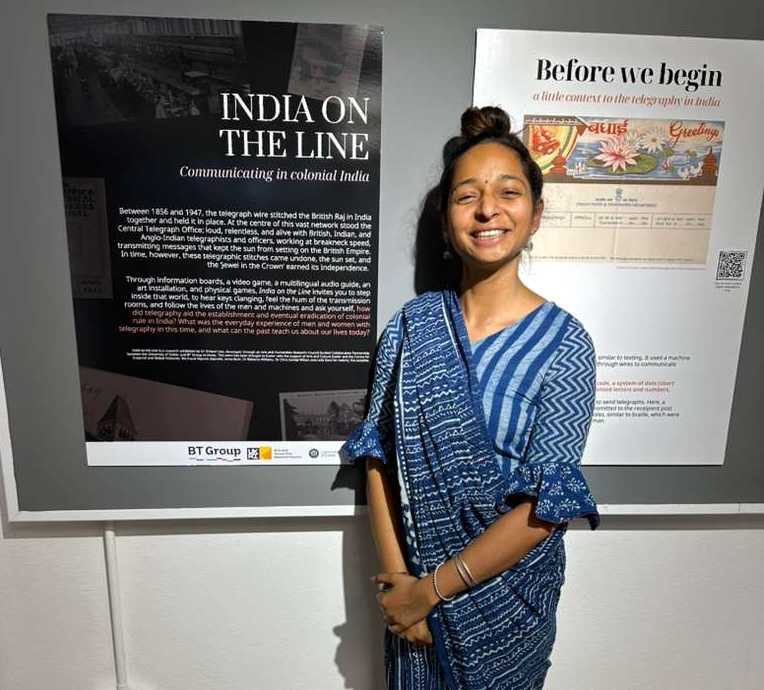
Dr Shibani Das reflects on the experience of curating and creating a public exhibition as part of her PhD.
Kenneth S Sheppard, Rustamji Sorabji Madon, Faizur Rehman, Joseph H Owens
These officers in the Indian telegraph department between 1931-41 have stepped out of reference books stored within the India Office Records in the British Library to occupy temporary spots on a wall in the west wing of the Queens Building, University of Exeter. These Anglo Indian, Parsi, Indian and Domiciled European men were born and brought up in an India balancing on the precipice between colonial extraction and political independence. They sat at the forefront of communication technology in their times. Their location? Behind a transmitter in a dusty telegraph office.
Claiming a larger space
Kenneth, Rustam, Fairuz and Joseph’s stories represent the multitudes of everyday histories that dissipate into the blur of archives viewed through the colonial lens. Their honorary place on the wall here in India on the Line: Communicating in Colonial India might be the largest amount of space they have occupied in anyone’s mind for decades.
A little more is known about officers such as Conrad Reginald Cooke, Chief Engineer of the Pakistan Telegraph Department, who published an autobiography and had the good sense of enrolling his descendant and my colleague in the University of Exeter! His life in India, his career, his friendships and enmities provide a never-before-assessed glimpse into the day to day lives of technicians, telegraphists, cleaning staff and executive staff in a government department.
Their work changed how time, speed and communication itself were experienced in the middle of the 20th century. Discovering Cooke’s autobiography also opened new methodologies of studying technology in empire from a bottom-up approach, unveiling other sources such as M.S Kalyanasundaram and Charles Coverdale. It is these men who form the heart of India on the Line.
An exhibition born from collaborative research
I curated the exhibition as part of my PhD, Race, Ethnicity and Telecommunications in Britain and its Empire. The project was funded by the BT Group Archives, as part of the Science Museums and Archives Consortium (SMAC). The exhibition introduces a new perspective to how we understand telegraphy and its role as an Imperial powerhouse. The 12 panels include a video game, a multi-lingual audio guide, two analogue games, an original art installation and photographs from the Science Museum Collection. These whisk the reader back to the 20th century and remind them that no matter how revolutionary the technology, it is the human stories behind it that truly make technology life-changing.
Hurdles and delays in public engagement
Communicating in Colonial India might have been slightly easier than communicating about Colonial India in the United Kingdom today. Numerous hurdles emerged during the curatorial process. A cut to the exhibition budget meant all components had to be developed in-house without compromising the quality of output. While my sister helped finalise the design elements, my mother and a friend’s father translated and recorded the multilingual audio guide. A friend’s car helped transport the exhibition between venues while refreshments for attendees consisted of a quick stop at the local Aldi. Once the exhibition and its interactives were developed, they were confronted with a wall of institutional colonial discomfort. There were delays and a reduction of accessibility to the exhibit. Numerous failed attempts at diplomacy gave way to an exhibition that looked and felt very different from what I had imagined.
A warm reception to discomfort
Luckily for heritage communication, what I thought had very little to do with how the debut of the exhibition in London was received! We were fully booked out after our first week and had to extend opening hours to accommodate growing interest in the exhibit from both within and without BT Group. This was a testament to the public hunger for historically accurate but human storytelling, even if it is about conventionally ‘uncomfortable’ conversations.
A year later, India on the Line returned to its home in Exeter thanks to the support provided by Arts and Culture Exeter, the Centre for Medical Histories and Leila Dara, a doctoral student in Ethno-political studies at the university. It was launched on the 30th of April with a panel discussion titled, ‘Technology and Empire: Then and Now’ featuring Professor William Gallois, Dr Debra Ramsay and Dr Cemih Salek. I followed the discussion by leading a curatorial walk.
India on the Line is a part of a contested, conflicted and emotional conversation that is worth having. One wherein we remind ourselves that our historical past is as human as our present, in which technology brings us closer, drives us apart, influences how we live, eat and speak, and how we resist power and fight to retain our freedoms. Do come and explore the exhibitions and send feedback to sd720@exeter.ac.uk.
The exhibition is on display at the Queen’s Building on Exeter University’s Streatham campus from the 27th of April to the 4th of August 2026. Sign up here for curatorial walks throughout June 2026.
Dr Shibani Das has recently completed her AHRC CDP funded PhD project, a cultural biography of telegraphy in colonial modern India from the 1920s to 1950. Her focus ranges from the everyday history of technology to gender and decolonizing the social history of Science in India. Shibani completed her Bachelor’s and Master’s in History from Delhi University, India before continuing her work with Delhi-based museums and heritage organisations. She has extensive experience working with museums to develop programs that enhance accessibility to students, neurodivergent audiences and the public in general.
Dr Das is taking up a new role as the PM Greenbaum – EP Abraham Curator of the Scientific Revolution and Industrial Age(s) at the Museum of the History of Science, Oxford.